
THIS MONTH IN KOREAN HISTORY - September 2026
History of Books and Printing in Korea
By Sharon Stern
Jikji (Korean: 직지심체요절) is the abbreviated title of a Korean Buddhist document whose title translates as "Anthology of Great Buddhist Priests' Zen Teachings" Printed during the Goryeo Dynasty in 1377. It was designated as UNESCO Memory of the World on September 4, 2001.
Books help us remember. They tell us stories. They take us to other places. They help us make sense of the world, help us explore the unknown, help us structure our lives and communities. Books explain what others might expect of us, what the universe might expect of us. A culture that loves books loves people and wants people to be the best versions of who they can be. The written history of Korea tells us that it has always been such a place. Korea has always been at the forefront of creating new and better ways to capture ideas, thoughts and history in written forms, as we will see in this month’s exploration of history.
Most Westerners believe that the first book printed using movable metal type was the Gutenberg Bible when Johannes Gutenberg printed the 42-line Bible in 1455. However, Korea had already printed a significant document using movable metallic type in 1377 – 78 years before the Gutenberg Bible! UNESCO entered the volume printed, called Jikji (직지), into the Memory of the World Programme, which recognizes documentary heritage of significance, in September of 2010. To celebrate that recognition, we will take a look at Jikji, but also look at the history of books, of printing and all of their pieces in Korean history this month, because Jikji is not Korea’s only first or unique accomplishment in this domain.
*Throughout the article - click on any image to enlarge
History of Books in Korea
Traditional process for making Korean paper, Hanji.
Truly ancient writings in East Asia were kept on a variety of materials, including animal bones, turtle shells, pieces of wood and silk. As techniques for refining materials evolved, writings in East Asia were created on wooden tablets and ceramic vessels, pieces of silk and slips of bamboo. The creation of paper from hemp emerged in China around 200 BC. Early papermaking techniques entered the Korean peninsula from China during the Three Kingdoms period (57 BC – 668 AD) and is believed to have entered in the first century AD.
From the Three Kingdoms period up until the Joseon Dynasty which began in 1392, Buddhism was the state religion of Korea and became its own, unique form of Buddhism. Buddhist texts dominated early printed books in Korea. The technique of creating a long scroll attached to a bamboo slip was originally done on silk and this format was copied when paper began being made. Individual sheets were printed with wood blocks and numbered and then assembled together into a single scroll.
early books
A replica of the Great Dharani Sutra of Immaculate Pure Light, from the collection of Rare Book School. The original, created in Korea around 751, is likely the earliest extant printed text in the world. Credit NYTimes.
The earliest known existing woodblock printed scroll anywhere in the world was found during an excavation at the Sokka Pagoda at Bulguk Temple in Gyeongju in 1966. It was dated to before the construction of the temple, which happened in 751 AD and after its translation into Chinese from Sanskrit, which happened in 704 AD. The scroll is of the Dharani Sutra (Korean: 무구정광대다라니경, 無垢淨光大陀羅尼經). A sutra is a collection of principals in a type of manual or textbook, if you will. The text focuses on the Buddha of Infinite Life and invokes a goddess who personifies the Buddha’s compassionate light. This temple space is unique and important in Korean Buddhism, built by the Silla Kingdom and meant to represent the Buddha’s realm on earth. The printing techniques were very sophisticated and the paper was Korean hanji paper, which we will describe below.
Silla Transcription of Avatamsaka Sutra (The Flower Garland Sutra), Zhou Version, in Ink on White Paper, Volumes 1-10 and 44-50
Another important early Buddhist sutra Korean woodblock scroll was the Shilla Avatamsaka Sutra or Buddhāvataṃsaka-nāma-mahāvaipulya-sūtra (신라백지묵서대방광불화엄경 주본, 新羅白紙墨書大方廣佛華嚴經), which was written over a 500-year period after Buddha’s death. The Korean scroll of this sutra dates to 755 AD.
The painstaking work of carving intricate wooden blocks for printing Buddhist sutras was seen as a labor to create merit. In Buddhism, merit is a force created by good deeds, which can bring good circumstances to a person, both in the current life and in the next. But the act of spending the time and effort replicating the text is not the only value. Passing on the knowledge and preserving it for the future is equally important.
Samguk Sagi and Samguk Yusa
These two books tell the story of the Three Kingdoms of Korea: Goguryeo, Baekje and Silla, which existed from 57 BC to 668 AD. While not unique in their printing methods or materials, they are the oldest known surviving written history of the Korean peninsula. Their importance lies more in their content than in the physical way they were produced.
Samguk Yusa
The Samguk Sagi is the first book ever compiled by a Korean government. It is written in Classical Chinese, which was the language of the educated class. It was completed in 1145. It consists of 50 “books” on scrolls and covers the history of all three kingdoms. A significant portion of the entire book has been translated into English, broken into separate books by kingdom, and can be purchased or borrowed from specific university libraries.
Its Buddhist counterpart, the Samguk Yusa, is a collection of myths, folktales, legends, but also historical accounts. It was compiled by the Buddhist monk Il-yeon late in the Goryeo Dynasty, around 1280. It was written during the Mongol invasions of Korea, when many cultural treasures and much classical literature was destroyed (see Triptika Koreana below). Il-yeon wanted to preserve folktales and stories that had been handed down orally or whose original texts no longer existed. It was intended to be an accompaniment to the Samguk Sagi. It is also written in Classical Chinese and is classified as a national treasure by South Korea.
The Samguk Yusa consists of two books and five volumes. It includes a brief chronology of the Three Kingdoms period. Because of the inclusion of songs and poems, it is an invaluable tool for understanding ancient Korean. It has been translated into English and is available both in print and digitally online.
The Samguk Sagi and Samguk Yusa record information from the same period from very different perspectives – one from the point of view of a Confucian government scholar and the other from the point of view of a Buddhist monk. Those different perspectives help give a more complete picture of the period. The earliest physical copy to still exist was printed in 1512.
Triptika Koreana
The Tripiṭaka Koreana in storage at Haeinsa (2022).
The Goryeo Dynasty was established in 918 AD at the end of the Late Three Kingdoms period and it unified the fractious entities on the Korean peninsula. If you did not already know this, the modern name “Korea” comes from the name of this dynasty – Goryeo. King Taejo, the first Goryeo king, took unification seriously at all levels, marrying 29 women from prominent regional hojok or regional leaders, resulting in 25 sons and 9 daughters. He did this to unify his power and to bring conflicting regions together, as well as to strengthen the presence of the power of the king.
In 993, the Liao Dynasty in China began a series of invasions into Korea now referred to as the Goryeo-Khitan War. Goryeo’s victory at the end of this conflict established its dominance in the region and ushered in a period of around 100 years without conflict, allowing for the development of intellectual and artistic achievements.
This period is known as the Golden Age of Buddhism in Goreyo. Buddhism wasn’t just a religion in Goryeo Korea – it was the driving force behind art, education, technological innovation and military strategy. It was present throughout all levels of society and especially prevalent in decisions of governing and government. International trade in both goods, but also knowledge, was centered in Goryeo’s capital in Kaesong (now North Korea).
The Tripiṭaka Koreana.
During this period, Goryeo invented the double-entry bookkeeping method used until the 1920s. The national civil service exams were established, opening influence for more families into the government, attempting to create more social balance. Major institutions of learning were created, reforming and strengthening the national education system. The infamous Korean celadon (greenware) pottery was perfected, in part because of the tea culture that arose out of Buddhism. Korea’s pottery techniques for clay formulas, firing and glazing were unique and the pottery was strongly sought after across Asia and Arabia.
At the end of this period of peace and innovation, conflict encroached on the Korean peninsula once again. Goryeo’s power and influence were challenged. They were invaded by the Jurchens. There were attempts to re-establish Silla rule. The Khitans, fleeing the Mongols, invaded Goreyo. The Mongols followed, in their pursuit of the Khitans.
Map of Goryeo-Mongol War in 1232.
Replication and printing of international books was viewed as critically important during this time, in order to spread the knowledge of philosophy, literature, theology and science. Hand-replication of books was also common. The replication of Buddhist scripture in any format was seen as an act of worship. This made Buddhist temples centers for learning, art (scriptures were often illustrated) and even technological innovation.
During the Goryeo-Khitan War, before the Golden Age of Buddhism, the carving of a set of woodblocks to print the Korean Buddhist Canon began. The name for this collection is now called the Triptika Koreana. The name in Sanskrit means “three baskets” which refer to the three parts of the canon: the Buddha’s own words, rules on monastic life and commentaries on sutras. The Triptika was a compilation of all known Buddhist thought from every corner of Asia and Arabia. It is the most complete compilation of Buddhist writing known to exist before modern times. Just the fact that all of those writings had been compiled in one place is extremely impressive.
The carving of the woodblocks to print the Triptika was dictated by the government as an act of creating merit, in the hopes that it would bring help from Buddha against the Khitans. It took eleven years to carve the original Triptika. Hundreds of people, not just monks, participated in carving the double-sided blocks used to print the Triptika.
When the Mongols began their second invasion in 1232, the original Triptika was burned. This was a devastating cultural and physical loss. The response by Goryeo was to begin re-carving the entire Triptika almost immediately. It was truly believed that the creation of the original Triptika had helped to repel the Khitans out of Goryeo. The wish was to accomplish the same with the Mongols. It was also an enormous cultural loss that the government didn’t want to let stand. And the spiritual value of the texts was culturally very important, not just in Korea. A dedicated bureau of the government was set up to accomplish the task of re-carving the woodblocks by providing oversight and materials. Just the quantity of wood needed was enormous. Each block, carved on both sides, ends in the text “to invoke Buddha’s protection.” This was not a throw-away line, but an imploring prayer.
In the end, after 12 years of labor, 81,352 blocks were created. The Triptika is also referred to as the Palman Triptika – “palman” or 팔만, meaning 80,000. These weren’t just a copy of the original. Every text was re-analyzed and corrections were made. Missing pieces were found and added.
A Monk showing the Triptika to the press. Scholars agree that it would take one about 30 years to read the full Triptika.
After 770 years, the Triptika not only still exists, the blocks are in pristine condition due to the unique treatment of the original cherry and pear wood, which included soaking it in salt water for three years, slowly drying it and using lacquer made with tree sap. Perfectly constructed buildings now house them, which create a unique design of air circulation and discourage rodents, insects and humidity from attacking the wood that the blocks are made of. The buildings they are stored in were created two hundred years after the Triptika itself and the location was very carefully selected and created and include features such as clay floors mixed with charcoal, lime, salt, calcium oxide and sand to reduce humidity and repel insects. It is the oldest existing version of the entire Buddhist canon of East Asian Buddhism. Annually, the blocks are brought out into the sun as part of their preservation process and a parade of the movement of the blocks takes place.
Haeinsa Temple.
The Triptika is a National Treasure of South Korea and is registered by UNESCO as a Memory of the World. You can visit the Haeinsa Temple in South Gyeongsang Province and although you cannot go into the storage buildings of the Triptika, there is much history to be seen and learned about there and a copy of one of the blocks is available for you to print from. You can also do a temple stay at Haeinsa for a more reflective and personal experience.
The Veritable Records of the Joseon Dynasty
Annals of the Joseon Dynasty (조선왕조실록)
Also known as the Annals of the Joseon Dynasty (조선왕조실록) or sillok (실록) for short, The Veritable Records are believed to be the longest continual record of a single dynasty in the world. 1,893 volumes cover records of the monarchy and government from 1392-1865. They are recognized by UNESCO in the Memory of the World registry and are a national treasure of South Korea.
During the Joseon Dynasty, keeping records of what happened in the palace and within government aligned with Neo-Confucian principles that good governance required memory of the past. Court historians were responsible for creating daily records of court activities. They accompanied the king at all times and the king did not conduct any official business without an historian present. No king was allowed to read the records of his own reign. After a king’s death, the records were compiled by a group of high-ranking scholars. Primary sources were collected and the historians created a first draft. Two more revisions were made to create the final draft and when the final draft was complete, the first drafts were destroyed. The historians were allowed editorial discretion and independence, including from the king. Only the historians were allowed to see or touch the documents and if any historian altered a document, the punishment was severe.
The website coreaverse.com states the value eloquently:
“For historians, the Sillok is nothing short of irreplaceable. It does not merely recount royal decrees and military campaigns — it captures the texture of an entire civilization: its debates, disasters, diplomatic maneuverings, cultural innovations, and the struggles of ordinary life as filtered through the eyes of the royal court.”
A famous example shows the editorial independence of the historians happened in 1404, during King Taejong’s reign, where the following appeared in the Annals:
親御弓矢, 馳馬射獐, 因馬仆而墜, 不傷。顧左右曰: "勿令史官知之”
Translation:
The king himself rode a horse and shot arrows at a deer. However, the horse stumbled, causing him to fall off, but he was not injured. Looking around, he said, "Do not let the historians know about this."
— The Veritable Records of Taejong, Vol. 7, article 4
Annals of the Joseon Dynasty (조선왕조실록), multiple copies were made to protect the records.
Beginning in 1445, three copies of the records were created and distributed across the country, in hopes that at least one would survive. During the Imjin War of 1592-1598, when the Japanese invaded Korea, only one copy did survive. Later, four copies were created, hoping to increase the odds of survival. Over the centuries, a few portions were lost. Under Japanese occupation, most of one of the copies of the records was moved to Tokyo Imperial University where it was destroyed in the Great Kanto earthquake of 1923. Some records are believed to have been looted after liberation in 1945. The surviving copies are housed at Seoul National University and the National Archives of Korea in Busan.
Jikji, Anthology of Great Buddhist Priests' Zen Teachings
Jikji is known to be the oldest book to be printed using movable metal type.
Most Westerners believe that it was Johannes Gutenberg that revolutionized printing by creating the movable metal type press in 1450. But 78 years early in Korea, a compilation of Buddhist teachings called The Anthology of Great Buddhist Priests’ Zen Teachings was printed using movable metal type.
There was mention of technology that used metal to make ceramic movable type by scholar Shen Kua (1031-1095) in China. He stated that movable type was invented by Bi Sheng (990-1051), during the Song Dynasty and described the process. In his book Brush Talks from Dream Brook, he says:
“He took sticky clay and cut in characters as thin as the edge of a coin. Each character formed, as it were, a single type. He baked them in the fire to make them hard. He had previously prepared an iron plate and he had covered his plate with a mixture of pine resin, wax, and paper ashes. When he wished to print, he took an iron frame and set it on the iron plate. In this he placed the types, set close together. When the frame was full, the whole made one solid block of type. He then placed it near fire to warm it. When the paste [at the back] was slightly melted, he took a smooth board and pressed it over the surface, so that the block of type became as even as a whetstone.
Each character existed in multiple versions, and common characters sometimes had twenty or more variants to accommodate repetition on a single page. When not in use, the characters were carefully organized with paper labels according to rhyme groups and stored in wooden cases. If an uncommon character was needed and had not been prepared beforehand, it was carved on the spot and fired in a straw-fueled kiln, producing a finished type almost immediately.”
It is commonly believed that bronze metal type was used in China to print money, but not mass-produced books, by the 12th century.
Korea, however, was printing books using movable metal type by the early 13th century. Movable metal type was being made by Choe Yun-ui in 1234, as documented by Chinese visitors. The oldest examples of these books did not survive, but some of the metal type from 1271 did. However, a printed work from 1377 has survived. The Anthology of Great Buddhist Priests’ Zen Teachings or 직지심체요절 – 직지 or Jikji for short – was printed at Heungdeok Temple outside Cheongju-mok in July 1377. The date is noted in the document. The work was actually printed in two versions, one using woodblocks and the other using movable metal type. The woodblock version was printed earlier, in 1372.
Replica of the metal print used to print Jikji.
The method for creating the metal type was involved. First, a master calligrapher would write the characters and carve them into wood. The wooden characters were pressed into wet sand, creating a negative mold. Molten bronze was then poured into the sand molds. When they cooled, they mirrored the wooden originals. The metal characters were arranged in a metal tray and wax was used to hold them in place. The plate was inked and paper was laid on the plate and burnished to imprint the text.
Only the second volume of one copy of the book has survived and it is currently housed in the Manuscripts Orientaux division of the Bibliothèque Nationale de France. The history of how it ended up there continues to be controversial. The French Consul to Seoul during the reign of King Gojong (1863-1907), Victor Collin de Plancy, acquired several hundred ancient Korean books and ancient ceramics, including Jikji, and brought them back to France. It isn’t clear exactly how he acquired the books and ceramics, but it probably occurred around 1910, when Korea was beginning its occupation by Japan. Jikji remained in his possession until 1911, when it was sold to the collector Henri Vever, who eventually bequeathed it to the Bibliothèque Nationale in 1950. The book entered into the library’s collections in 1952.
A Korean bibliographer named Park Byeongseon was working at the Bibliothèque Nationale in 1972 and identified the work and publicized about it. South Korea argues that it belongs to them. Many Korean objects were repatriated to South Korea during the presidency of François Mitterand, but not Jikji. The Bibliothèque Nationale sees the work as a document of shared global historical importance and believes that they can better care for its preservation. Jikji was entered into UNESCO’s Memory of the World registry in 2001. In 2006, South Korea opened the Cheongju Early Printing Museum at the site where the Heungdeok Temple where the document was created once existed. Discussions continue between South Korea and France about the future of the document.
After Jikji, many different metal movable type faces were created. Both wooden and metal movable type were produced both by the palace and by citizens for printing. King Taejong (1400-1418) added copper type to government printing. King Sejong, who was the inventor of the hangeul alphabet, created the Gagninja type face, which was a uniform and not irregular type. 200,000 characters were made in this type face and the uniformity made printing faster. Hangeul type was also created.
Korean Materials for Creating Books
Not only does Korea have an impressive list of historic firsts in books and printing methods, the materials used to create the books were also unique and sought after by other countries.
Korean Paper and Ink
Papermaking began in China around 100 AD and it is believed that Korea was making paper by the 3rd century based on the fact that paper was found in an ancient tomb by the Joseon Archeological Site Research Group in 1931. The tomb dates to the Naknang Period, from 108 BC to 313 AD.
Korean Traditional paper Hanji.
Korean hanji paper was unique and highly valued by the Chinese for its bright color and smooth surface. The Chinese were making paper from hemp and rice. Hanji was made from the inner bark of the mulberry tree. Mulberry bark paper was present in Japan and most of the Pacific, but Korea’s techniques were superior and unique. The paper was very strong and was treated with plant secretions to both bind it and to repel insects.
To make the paper, mulberry bark was stripped and separated. It was called baekji because it was said to take 100 (백 or baek in Korean) hands to collect and process the mulberry bark for a single sheet of paper. Handmaking paper is always labor intensive, but using this material was especially labor intensive.
The bark was dried, boiled with ash from buckwheat stems, rinsed and pounded, the pounding making the fibers stronger and more interwoven. Mucilage from a type of hibiscus was applied to the pulp to help it not degrade over time, not change color and to repel insects. The Chinese compared the paper to silk because of its white sheen and incredible strength. There are hanji paper samples that have not changed color or deteriorated in 1000 years. During the Goryeo Dynasty, Korea’s hanji paper was traded around Asia and into the Arabian Peninsula.
When the Joseon Dynasty began in 1392, more and more books were being printed. Colored paper became popular. Paper began being used for household objects like fans, tobacco pouches and parasols, as well as books. Mulberry bark began to be harder to get ahold of, because the process killed the tree. Later in the Joseon Dynasty, other materials had to be added, using different varieties of mulberry as well as other plants and the quality of the paper declined. During the Imjin War (1592-1598), Japan enslaved many of Korea’s best artisans and the best papermakers were taken. Joseon turned to Buddhist monks to help make paper. During the Yuan, Ming Qing Dynasty invasions and consequent required tributes that Korea had to pay to the Chinese Dynasties, large quantities of paper were sent to China. All of these stresses led to a decline in the quality of paper that Korea produced.
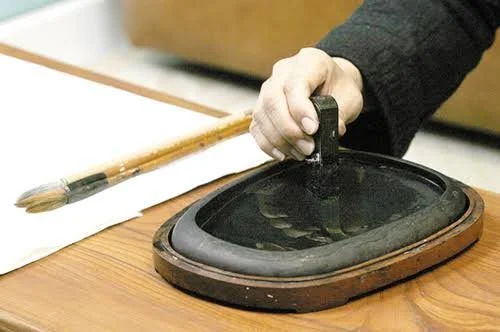
Ink Stone, 벼루, and Ink 묵.
Hanji papermaking techniques are still alive, however. You can buy beautifully handmade hanji paper and you can even take hanji papermaking workshops in Korea.
Korean ink sticks used for calligraphy were exported to China during the Three Kingdoms period because of their superior quality. Ink was part of what Chinese Dynasties requested in their annual tributes during the Joseon Dynasty. Ink formulas were also unique in Korea and sought after by China and other countries. The exact formulas are recorded in the government documents from the Three Kingdoms, Goryeo and the Annals of the Joseon Dynasty. Ink has also been discovered and analyzed in the excavation of tombs and temples. Pine ash mixed with the fat of water deer made ink that absorbed deeply into hanji paper without bleeding and that would not fade over time, but the exact formulas were continually perfected.
Books evolved from being made on long scrolls, which had mimicked the early writing onto silk, into multiple scrolls, folded scrolls and then many different kinds of bound sheets of paper. Korea’s book binding techniques carefully took into account the details of preservation that had gone into the making of the paper and ink. Materials could not be used that would compromise the longevity of the paper or ink. Bookbinding is such a complicated subject that it could easily occupy its own article.
Conclusions
Collection of Wooden scrolls, 목간, before the invention of traditional paper.
Books, writing, printing, and replicating information are crucial for us to understand our past, which enlightens our present and hopefully improves our path to the future. Korea took the preservation of information and ideas for its society very seriously. But we need to stop and consider that the way we know this is that pieces of those efforts still exist. Why is it important that the earliest pieces of paper, the earliest woodblock scroll, and the earliest movable metal type documents came from Korea? It’s great to have a number of records credited to Korea, but the importance is more profound than the records. These documents still exist. They were created in such a way that they would last longer than any other culture’s efforts. The work put into making sure those records would last was equally important as the records themselves. Thank you, Korea, for caring so deeply about knowledge, history, the preservation of thought and contemplation that we can still learn from your ancient wisdom today!
Further Reading
https://coreaverse.com/2026/07/jikji-the-worlds-oldest-metal-printed-book.html
https://dh.aks.ac.kr/~cefia/wiki/index.php/Early_Printing_in_Korea_-_Foreword
https://korealogue.com/en/history/why-was-tripitaka-koreana-carved/