THIS MONTH IN KOREAN HISTORY - May 2026
Women in the Gwangju Uprising
By Sharon Stern (with additional reporting by Eun Byoul Oh)
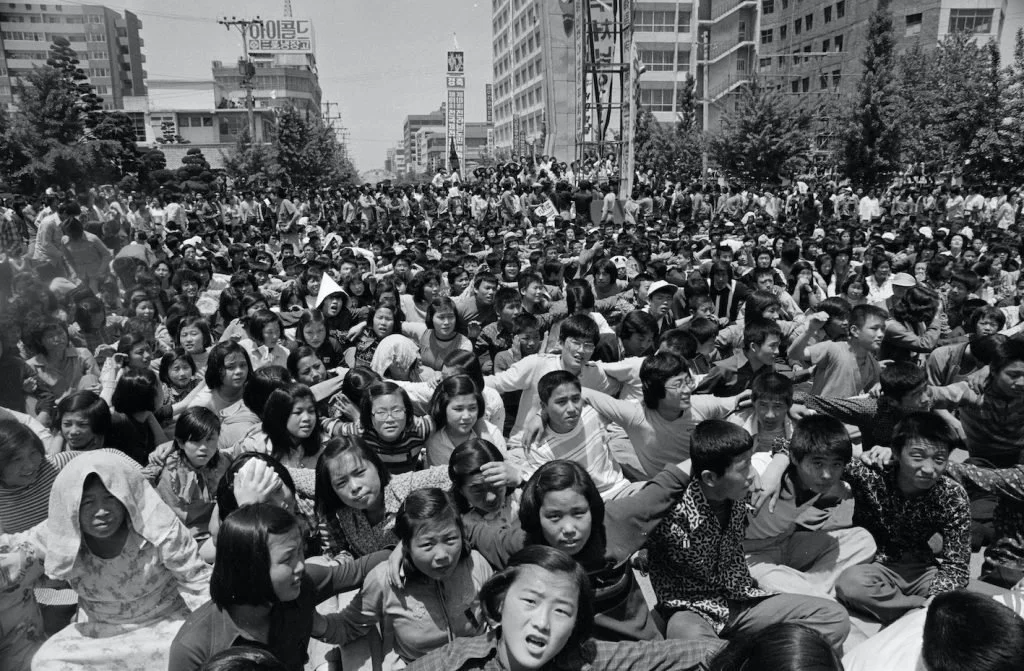
Female Students on the street in Gwangju 1980. Photo credit: Lee Chang Seong. 5.18 May 18 Memorial Foundation.
When I was growing up, I had a friend, E, who I am very lucky to still call my very dear friend. Her father was a history professor at the university. One day, I was at her house and we were talking about wars between England and France and her mother and father had a discussion for my benefit. Her father was explaining how important it is to understand and study history. Her mother told me, quite emphatically, that you cannot trust history, as it is written. History is recorded by the victor, and is therefore skewed, and it has almost always been written by men. That got my young brain pondering and it is an idea I still ponder today. I think there is a lesson here for this month’s history article, so I will dedicate this article to E’s parents.
May 18th marks the anniversary of the Gwangju Uprising and this year we decided to focus on the voices of women during this most critical juncture in South Korea’s modern history. It ended up being very difficult to find direct witness testimony from women who were a part of this history. There are a number of reasons why and those reasons are an important a piece of the history, along with the testimony itself.
Women made up at least a third of those protesting and organizing during the Gwangju Uprising and yet their stories have not been widely heard, even today. The country was slow to publicly recognize the horrific atrocities of the Gwangju Uprising and, even when they did, women’s stories were completely excluded. That needs to change, as do the reasons why women have stayed silent. Please read on and do your part to help keep this part of history alive.
Let’s briefly look first at what the Gwangju Uprising was and then we can drill down into women’s roles.
What Was the Gwangju Uprising?
The Gwangju Uprising is also known as the May 18 Democratization Movement. It began on May 18, 1980 and lasted for ten days. Last year, we covered the history in more detail and you can read that article here. BBC Witness History aired a recap of the event here. We will review some of the history now.
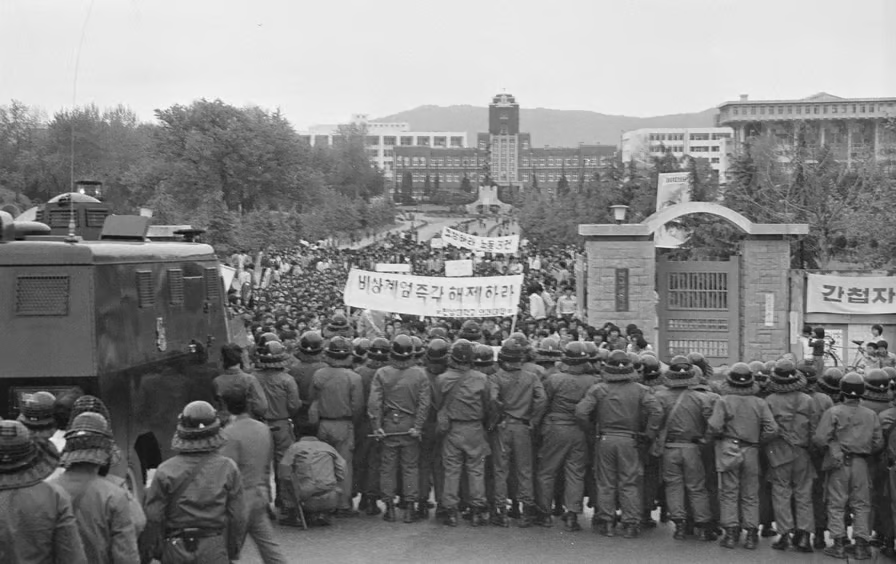
Chonnam National University, where the Gwangju Uprising began, on May 18, 1980.(May 18 Memorial Foundation).
In October of 1979, President Park Chung Hee was assassinated, which sparked widespread protests throughout the country. At the end of 1979, Chun Doo-hwan staged a coup against the civilian puppet government of Chio Kyu-Hah and declared martial law on the entire country, including Jeju Province. The martial law closed the universities and made political activities and protests illegal. On this same day, the KCIA raided a national conference of student union leaders from 55 universities that was taking place. In addition, 2,700 individuals and 26 politicians were arrested.
The following day, May 18, 1980, the Gwangju Uprising began. The Uprising began when around 200-600 students of Chonnam National University began protesting martial law in front of the university. The military shot and beat protesters and bystanders and took many away where they were tortured and some killed. When the citizens of Gwangju saw what had happened, they joined the protests.
As the conflict escalated, the army opened fire indiscriminately on May 20th near Gwangju Station. Protestors set fire to the MBC and KBS broadcasting stations for disseminating misinformation about what was going on. On May 21st, television and radio broadcasting was silenced. The army fired on a crowd at the Provincial Hall and militias broke into police stations and army reserve armories to steal weapons. A firefight between the two sides took place early in the evening. The army then retreated, but everyone knew they would return.
On May 22nd, the army blockade the city, not allowing supplies or people into the city. The Citizen’s Army organized itself, headquartering at the Provincial Hall, readying for the return of the army. On May 27th, the army returned with multiple brigades the descended into the downtown area and overtook the militias within 90 minutes, killing many. By the end, an estimated quarter of a million people had participated and between 1,000-2,300 were killed. Up to another 3,500 were wounded. This incident was a critical step by the people of Korea towards democratization, even though it took another seven years to get there by forcing the military dictatorship out.
Women’s Social Roles Before 1980
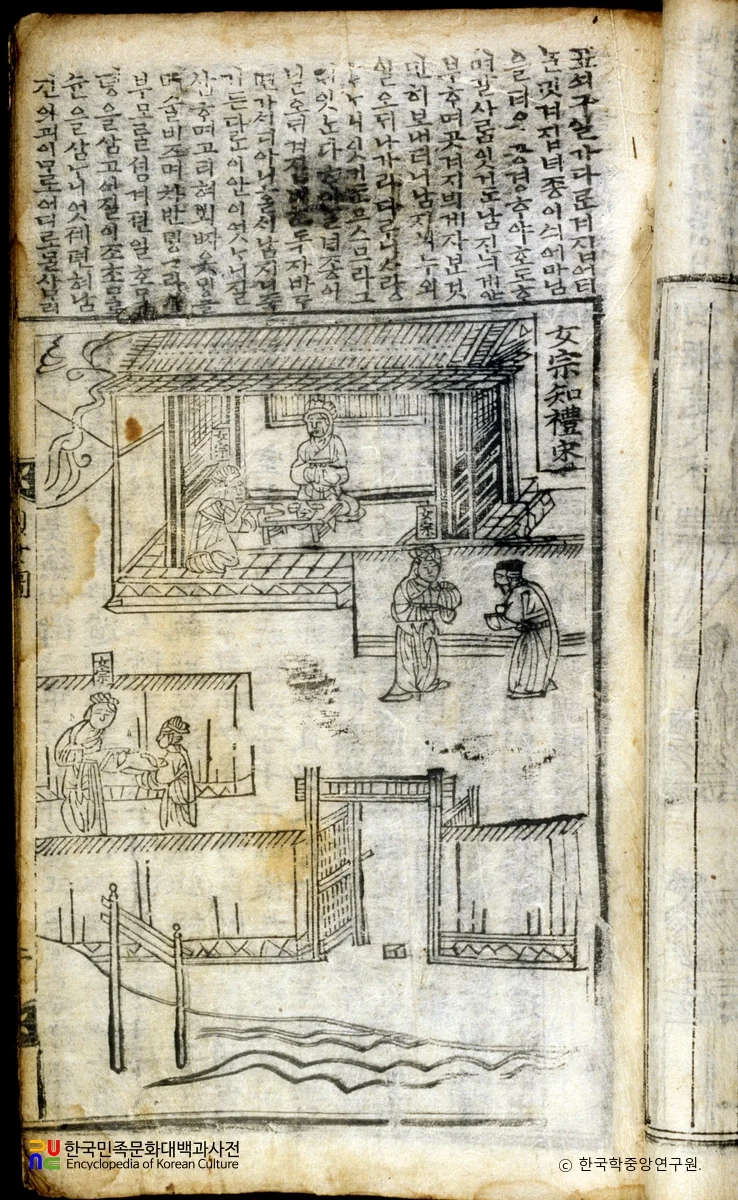
A page of Samganghaengsildo (삼강행실도), about 삼종도 (Three Principles of Obidience for Women), which states that women must follow their parents at childhood, her husband after marriage, and her son after the husband dies.
Women’s roles in Korean society were dictated for centuries by Confucian principals, which imposed a strict hierarchy of classes and a role for women that was in subjugation to men. At the base of Confucian belief, adherence to social structures is believed to create balance in society, balance in nature and balance in the heavens. Individuals needed to submit to their inherited roles of class and gender for the betterment of the entire society. Women were believed to be inferior to men. Women were subjugated to their fathers before marriage, to their husbands during marriage and to their eldest sons if the husband died. Women stayed at home, were not educated and served the men they were subjugated to. These fundamental principles are strongly entrenched in the history of Korean society and therefore in the social fabric that still has influential today, whether or not individuals know that history.
An emphasis on women’s role as child-bearer was also fundamental in the concept of the complimentary and yet opposite elements of Yin and Yang. In addition, a woman brought honor to the family and thus to society by maintaining blood lines and therefore any encounter, including rape, outside of the family structure, brought dishonor and shame to family, to the entire society and to one’s ancestors
The intersection of industrialization/capitalism and patriarchy brought large numbers of women from the countryside into the city and also into the workforce between 1960 and 1980. Prior to this time, women’s roles in industrial work were limited. Low paid jobs in labor-intensive manufacturing were seen as suited to easy-to-exploit women. Because women were viewed as inferior, the most unskilled and laborious jobs were given to women. Although women’s roles were changing, their social status was not. At the beginning of the 1960s, women represented 28.7 percent of the modern workforce. By 1980, they represented 36.6 percent. In agricultural production, the percentage was even higher at 44.2 percent by 1980. In labor-intense, as opposed to capital-intensive (white-collar) work, the percentage was 57.3 percent.
Sexual intimidation because of traditional beliefs were used to keep women in their place at work and force them to work extended hours in harsh conditions. A male boss could easily threaten a female worker with spreading rumors that she was not a virgin in order to get her to comply. The Miracle on the Han River – the industrial rapid growth of South Korean – was very much built on the backs of women.
Women’s Social Roles in 1980
Before the Uprising, many women were members of social organizations, such as the YWCA and church groups. A number of these organizations worked for women’s labor rights and towards women’s education. As women entered the workforce in greater numbers, they became aware not only of their collective place in society, but also of the collective power they could have. These social organizations were a place where women could promote and share their collective interests. Gender inequality was one of the interests that began to be discussed. Men in the workplace assumed that women would want to follow their agendas and did not represent gender-specific issues. When women protested their working conditions, they were often described as chaotic and hysterical by men.
Women continued to still occupy traditional roles, in addition to their expanding roles in the industrial workforce. Motherhood, homemakers and caretakers were dominant roles for women in addition to any work they might have had outside of the home.
Women’s Roles in the Gwangju Uprising
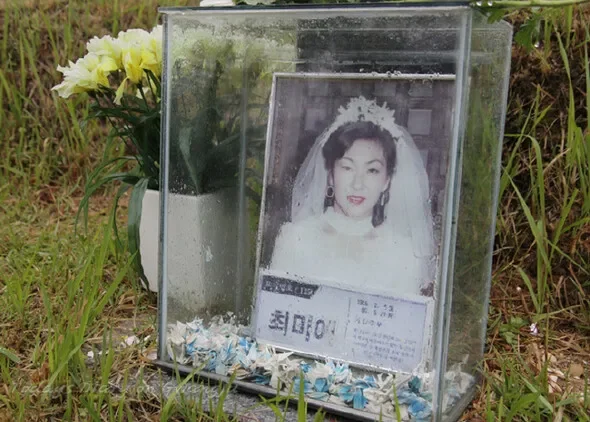
Choi Mi Ae was 8-month into her pregnancy when she was shot in the head by the military during the Gwangju Uprising. She was waiting for her husband outside of her house when they gunned her down. The unborn child died with her, and she was 23 years old at the time of her death.
Although the protests in Gwangju were begun by students, some of which were women, when the first group of people were gunned down in the streets on May 18th, some by soldiers in helicopters, the entire community quickly became involved.
Women made up at least a third of the participants in the Gwangju Uprising. In addition to protesting on the streets and organizing protesters, women tended to the wounded, prepared the dead for burial, made food for the armed groups. But they were also responsible for communicating information about what was happening, especially after radio and television were cut off. Women took on the role of street broadcasters by walking and riding through streets announcing information. They also hand wrote pamphlets of information and distributed them. Women were very literally everywhere. And women of every background participated: school girls, mothers, grandmothers, professional women, laborers, prostitutes.
On May 20th, women were present at Provincial Hall and were receiving training on how to use firearms and grenades. However, on May 21, when the Citizen’s Army took over Provincial Hall, they expelled the women and told them that only men could participate in the armed resistance.
This exclusion didn’t deter the women’s motivation, however. They had rallies to collect money for supplies. The prostitutes organized blood donations. Women made rice balls and hard-boiled eggs for the Citizen’s Army. Women were the center of communication. Women broke up concrete from city sidewalks for protestors to throw. Women made Molotov cocktails. Women transported wounded and dead bodies. Women hid protestors that the army was searching for.
There was a major distinction between what women did during the Uprising and what men did. Men were organized into groups, given instructions, followed a command structure. In contrast, women’s actions were spontaneous. No one was telling them what to do. They simply did what needed to be done. They were used to collaborating through groups like the YWCA and churches. They were constantly needing to do whatever was necessary to keep households running. Women that have spoken about their participation didn’t see anything unusual or heroic in what they did. They believe anyone in the same situation would have responded in the same way.
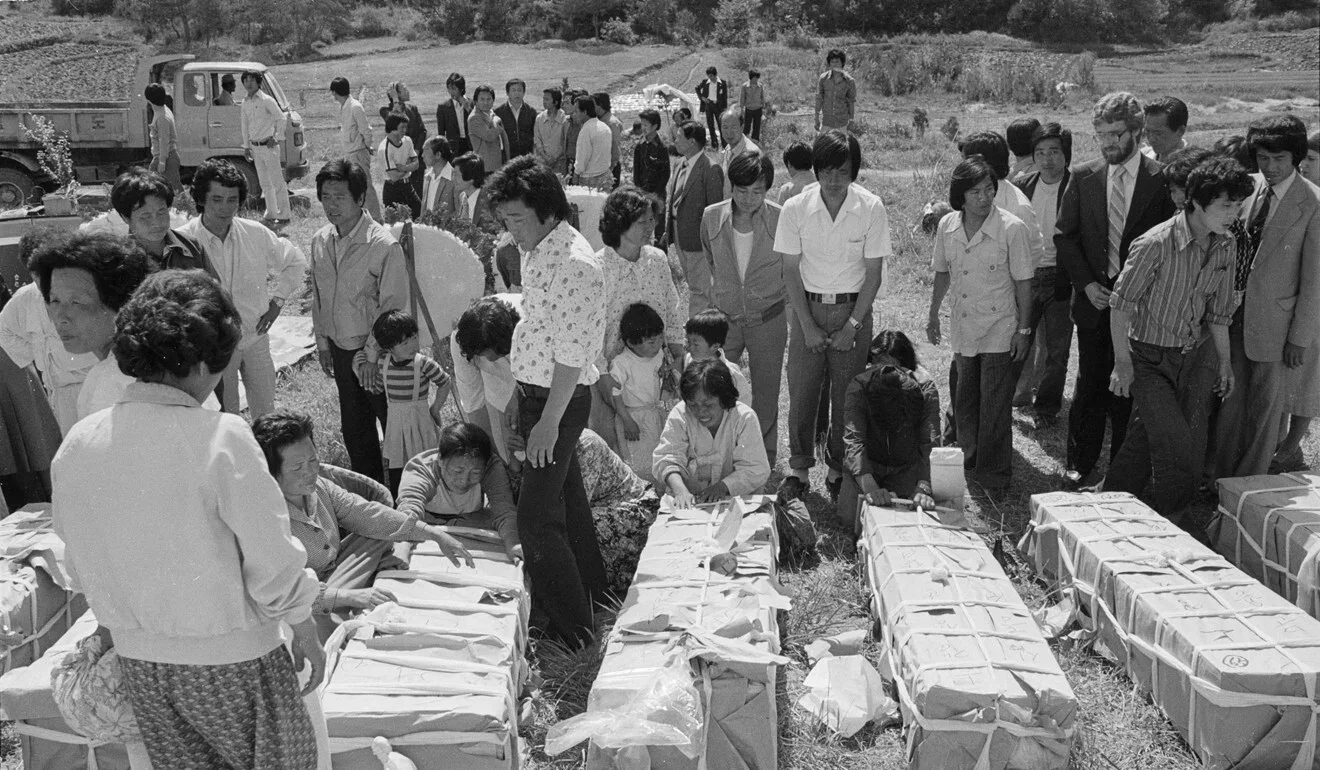
Families mourning victims of Gwangju Uprising.
Women suffered many abuses during and after the ten days of the Gwangju Uprising. Men also suffered horrible abuses, of course, but some of the punishment was intentionally gender-directed. Women were arrested and tortured, often with sexual violence and sexually explicit demeaning language. They were accused and consequently punished for hiding demonstrators. They were dragged to dark places and raped. They were raped as part of their abuse in detention. At least 17 gang rapes were committed on women and girls from 10 to 30 years old, including pregnant women. Women had their breasts cut off with bayonets. Women were forced to parade in public and urinate publicly while naked. Gender-based humiliation was a focus of the punishment women endured. Women’s bodies were absolutely central to both punishment and the resistance.
Why Are Women’s Stories Not Documented?
We need to remember that the Gwangju Uprising took place in 1980. That isn’t ancient history. Many of the women who lived through it are still alive today. Social factors that make their stories feel unworthy or tainted still exist. Even though all of the roles that women held during the Uprising were just as vital as those executed by fighting men, the value of these roles is seen as lesser, even today.
Guns Versus Rice
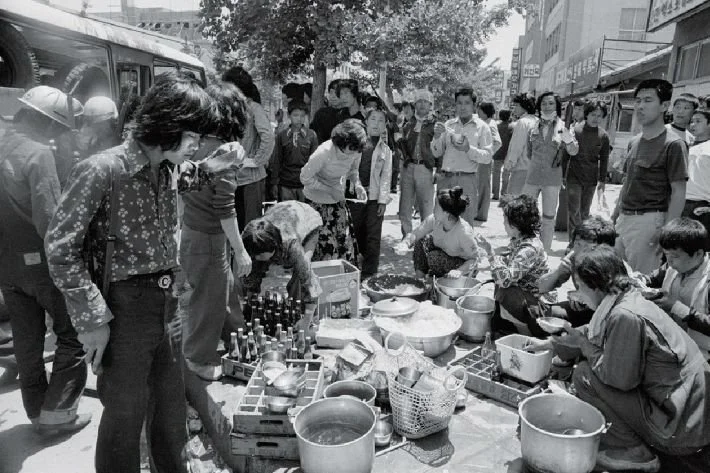
Women of Gwangju fed rice balls for the fighting men during the uprising at Daein Market. 5.18 Memorial Foundation.
When the country began reconciling the truth about the Gwangju Uprising, the narrative focused on the Citizen’s Army – the men with guns. The glory of the resistance was seen to be the armed men that fought back and then martyred. It was a hero’s narrative. Because women’s roles were spontaneously organized and executed, they did not have the political value that men’s roles were seen to have. One woman, who eventually gave testimony, said “If it’d been our job to fight with guns, we’d have done it. We did our job because it was what we needed to do, simple as that.”
In the aftermath and formation of narratives, the women who had made rice balls to feed the Citizen’s Army became a symbol of the only effort women were capable of giving. Narratives of women’s participation were condensed into rice balls. Women understood from these narratives that their stories didn’t matter – they weren’t to be heard. Women also suffered overwhelming survivor’s guilt. They were there. They had witnessed the massacre. They had been abused and humiliated. But they had survived and the guilt of that was enough to silence them.
Women Portrayed as Spies
At the time of the Uprising, the country was ruled by a dictator who was backed by the US. From the end of WWII, because it had been determined by the Four Powers (UK, US, Soviet Union and China) – essentially the countries that set up the UN - that Korea could not rule itself, the US and Soviet Union split the peninsula into two occupied zones. The US, throughout the division of the peninsula, throughout the Jeju 4.3 Uprising, throughout the Korean War and then throughout dictatorships, until the June Democracy Movement in 1987 and the introduction of democracy to the country, was hell-bent on making sure that Communism not take hold in the country. The narrative emphasis by the Chun Doo-hwan government was that the Gwangju Uprising was instigated by an infiltration of spies from North Korea. This narrative was perpetuated into the future and repeated by newspapers in the US. There is a major political party who, today, still repeat this narrative.
The Chun Doo-hwan government worked long and hard to repeat the story that the women who had worked as street broadcasters, who created pamphlets and who participated in protests were North Korean spies. Their continuous retelling of this narrative was effective, deeply implanted in people’s conscious, and women who had been arrested and tortured, labelled as spies, had a very difficult time reintegrating into their communities after they were released. They remained silent because anyone who found out that they had been in prison would not let them live in their neighborhoods, their families were ostracized, they were not employable and they were successfully cut off from society.
Portrayal of the Uprising Throughout the Country and Beyond
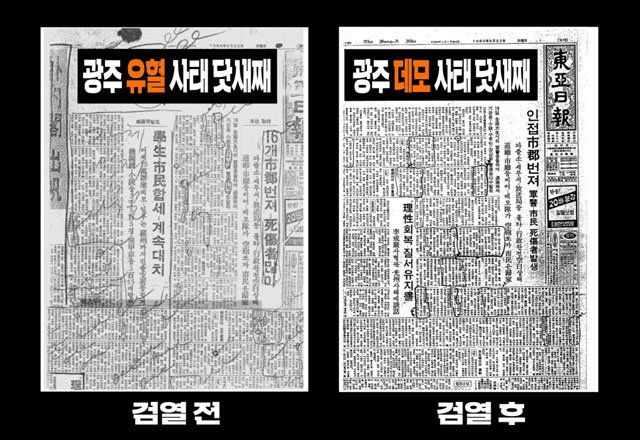
An image showing a side by side comparison of article reporting on Gwangju uprising before censorship and after. Photo Credit: KBS
The government spread propaganda about the Uprising immediately following the Uprising and until the dictatorship fell in 1987, giving them years to entrench lies into people’s views of what happened. They painted what happened in Gwangju as a Communist insurrection. They portrayed it as a violent riot that had to be controlled. They characterized participants as hooligans, subversives and criminals. They painted the situation as an isolated incident. US newspapers parroted these lies. True history from witnesses, however, tells us otherwise. But the effect of this propaganda right after the incident was effective, making everyone in Gwangju uneasy to talk about it. In addition, talking about the incident was made illegal everywhere in the country.
Memories of Comfort Women
Women who had been abused during the Uprising kept silent for yet more reasons. The memories of how the Comfort Women that had returned from WWII were treated had not been forgotten. Families had cut them off, rejected them and wouldn’t allow them to return home because Confucian beliefs that a women’s chastity is more important than her actual life meant that they could not return home. Fears that if abuses suffered during the Uprising became known, women could meet the same fate as Comfort Women meant that women stayed silent. Additional fears that their stories of abuse would not be believed because they would need to be confessed to men also kept them silent. The truly entrenched societal concepts of both subjugation and women’s need to be sexually virtuous play into the silence of women victims, for some, pushing them to suicide.
Individual Women’s Stories
Eventually, a few women became brave enough to tell their stories. It didn’t happen for decades. There are so many other stories out there that should be recorded. Some women that have met with female journalists have told their stories, but remain anonymous. We will highlight those that we can and be grateful for the bravery of these women.
Cha Myung-Sook
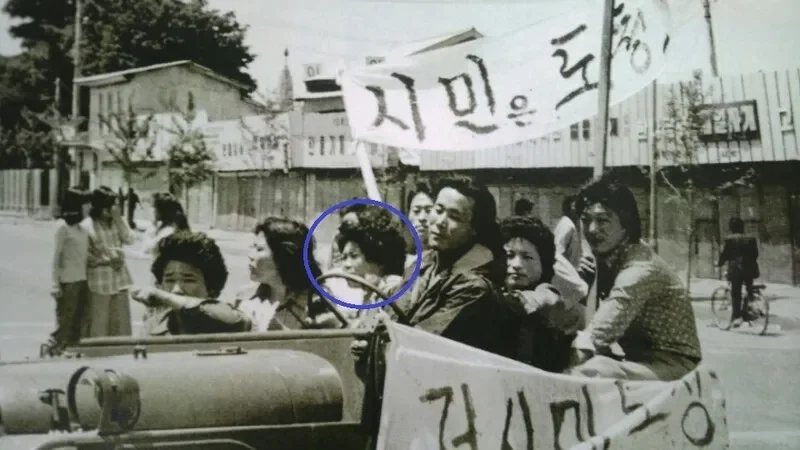
Cha Myung Sook with the broadcasting amp in the street.
Cha Myung-sook was 19 years old when the Gwangju Uprising occurred. She had wanted to attend university, but her father would not permit her to. She was attending the International Dressmaking School in Gwangju when the Uprising started. She had heard about the violence and demonstrations before May 18th, but the only available information came from church groups. On May 19th, after the first killings, people started organizing. On May 20th at about 10 am, she went to meet a friend. When the friend didn’t show up, she was headed back to her dormitory. It was then that she saw what was happening in the center of the city. She saw soldiers beating people viciously and didn’t understand why they would be beating civilians. She felt like she should help the demonstrators. She needed to tell other people what was going on, because normal forms of communication had been cut off. She and some university students met together to go to a neighborhood office and ask for a microphone and an amp. She had to argue with the people at the neighborhood office, but ended up getting an amp that had been on the roof. The amp and the speaker were set up in a small truck and she started broadcasting news. Ms. Cha was one of the first of what would be a group of female street broadcasters.
The amp broke down that same day, however. At 11 pm that day, she went to a radio shop and begged them to fix the amp. She pleaded saying, “Sir, please fix this amp. If we don’t broadcast, the people of Gwangju will all be killed.” They told her it would take several days to fix the amp. She pulled out a fake student ID (she had found it on the ground and placed her own photo on it) and borrowed another amp.
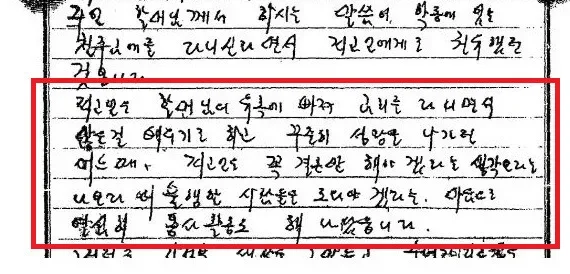
Cha’s written testimony dated in November of 1980.
She had been told that anyone that was going to broadcast should be using fake IDs and wearing wigs to protect both themselves and others. There were already a few foreign reporters filming, but they tried to confiscate their film and photos because they did not want people’s faces recognized. She was driven around town, proclaiming, “Your sons and daughters are all dying. Come out and protect Gwangju.” She recalled that there was so much blood and so many coffins. She said that she saw a truck that she thought had just been painted, but when she got closer, she saw that it wasn’t paint, but blood.
On the 20th, the army retreated. Everyone knew they would return. They left weapons as they retreated and the next day, people from outside of Gwangju, including a few police, brought weapons into Gwangju. This is when the Citizen’s Army got organized. Some police refused orders to shoot civilians saying that these were their brothers and sisters. Some police allowed protestors to use police uniforms to hide who they were.
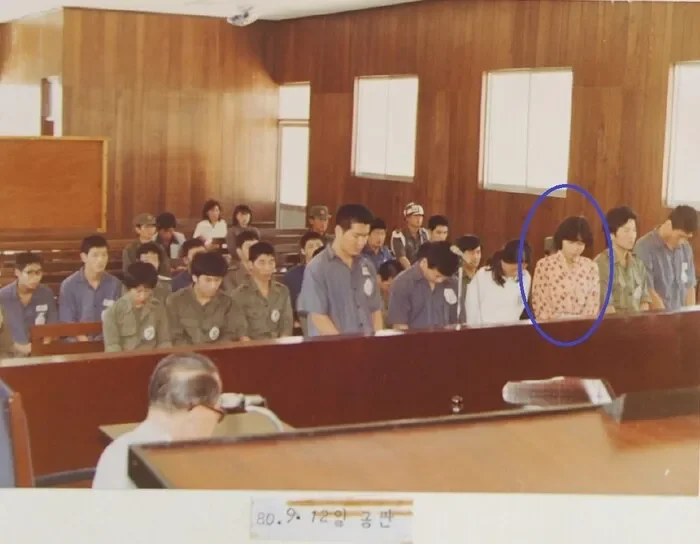
Cha standing in a military tribunal for her trial under the commitee of martial law on September 12, 1980.
On May 21st, she and other female broadcasters collected two bodies they had found near Gwangju Station and their announcements, as well as the grisly image of the corpses, grabbed people’s attention. She recalled, “The army didn’t think that women could mobilize people. They arrested a street broadcaster on the 20th. The army was shocked that women could be so effective. They began an investigation to try to find the street broadcasters. They framed these women as North Korean spies.”
On May 24, Ms. Cha recounts, “I had been on Geumnam Road when they opened fire on the public on May 21, and I’d escaped and hidden in someone’s closet. After the martial law forces had withdrawn from the city, I had gone to the old South Jeolla Provincial Office, which had become a base for the armed citizens’ militia, and I was loading the bodies at Christian Hospital when I was caught. I was at the hospital, cleaning the dead bodies and tending to the wounded. There were investigators specifically looking for me – they had a description of me. Investigators came to the hospital and found me there. They walked up and said, ‘I want to have a word with you,’ and arrested me.”
“I remember beautiful rows of green trees as I was led down steps below a building and was taken to an investigation room where I was tortured for three days. I was framed as a North Korean spy and they repeatedly asked who was the North Korean contact. They knew that I was not a North Korean spy. The narrative was that they were keeping order in society by getting rid of the North Korean spies. And they kept that order by getting rid of the spies.” She never confessed to being a spy just to make the torture stop. She held onto the truth throughout her torture.
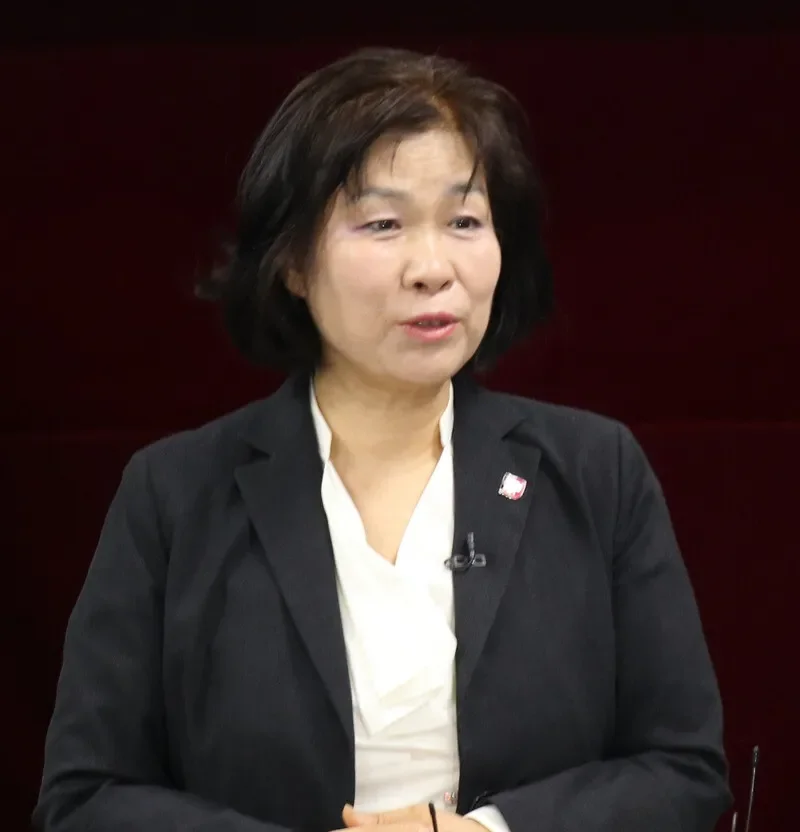
Cha Myung Sook at a press conference where she detailed the torture she had to endure.
She received a 15-year jail sentence. She was continuously tortured and in solitary confinement for two years. While in solitary confinement, her wrists were handcuffed to her belt. “My left wrist rotted away. My hands were black with chapping, like meat that’s been frozen stiff.” She survived by reading and writing.
After a military tribunal in 1981, she was allowed parole and given a stay of execution. The entire time she was on parole, she was followed by intelligence officers. Before she was released, military agents went to her hometown to spread rumors that she was a North Korean spy and that she had instigated rioting in Gwangju. Her father suffered a stroke and ended up dying after hearing this news. She said, “It felt like ice being poured on a corpse. For two more years, I wanted to erase the memory of everything that had happened.”
When the military drove her back to her hometown, no one wanted her there. “When I was in prison, I was alone – it was just me. When I was out on parole and being followed, my family, my neighbors were impacted and I knew that anyone could call the police at any moment. When I got out, the propaganda that had been distributed that I was a North Korean spy meant that there was always suspicion around me. Nobody believed me.” At this time, she met a priest who encouraged her to volunteer, to help others. She helped by doing the rituals for the deceased loved ones. She says she owes her life to that priest that helped her find purpose.
Ms. Cha tried to live her life without mentioning her connections to the Gwangju Uprising. In 2001, she was named a Meritorious Person because of her courage and her name became public. Her friends wanted her to talk about her experiences, but she didn’t want her children to have to see her name in newspapers and on TV. But a classmate of her younger child told her that he was proud of her and she decided to become more public. “I took my two children to Gwangju and held a press conference. I visited the cemetery where those that died were buried and I realized that their dignity needed to be respected. They are gone, but I am still alive. During the press conferences, I was able to say that if you were in the same situation, you just jump in and do the work – that is what people do. I didn’t’ do anything more than anyone would do as a solid citizen.”
In 2013, a retrial was held at the Andong branch court and she was acquitted of all charges connected to the Gwangju Democratization Movement. She felt like she could finally stand tall in front of her sons. In 2019, she was awarded the 3rd Gil Won-ok Women’s Peace Prize.
“There were young women and mothers who played important roles and that needs to be told both inside of Korea but also to the diaspora around the world.”
In 1985, Ms. Cha met her husband in Seoul at church. He husband’s family was well-established and lived a comfortable life. When she married, she was happy for the first time in her life. They had two children together. In 1989, however, television broadcasts of National Assembly hearings about the Gwangju Uprising made him ask her some questions. She admitted she was involved with people being mentioned and he was very upset. He had believed the rumors that what had happened in Gwangju had been organized by North Korean spies.
Park Young-soon
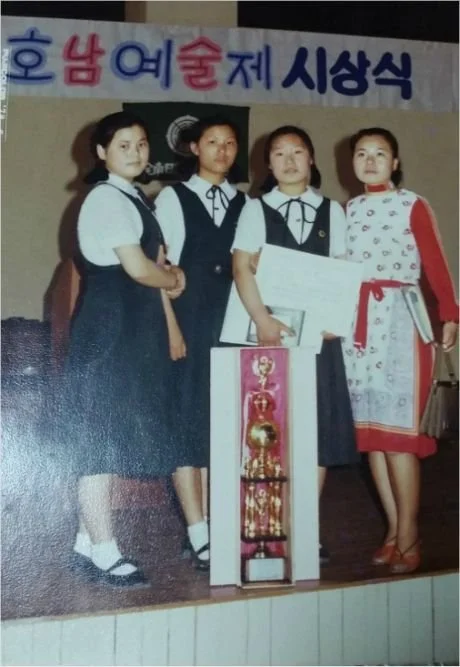
Park Young Soon with her students in 1979.
Park young-soon was the woman who did the last street broadcast of the Gwangju Uprising on May 27th. She was attending Songwon University and worked as a gayageum teacher at Gwangju Girls High School. She had heard rumors that there were protests, but hadn’t seen them yet. On May 21st, she had let her students go home and was trying to go home. She was in the area of the Provincial Office when she heard gunshots and screams everywhere. “At that moment, a van approached me, and I was asked by a male student riding inside to make a street broadcast to the people. Without a second thought, I got in the speaker-equipped van and started the street broadcasts.”
From May 21-26, she made street broadcasts from a van with a loudspeaker, driving around Gwangju and surrounding areas, telling people what had happened at the Provincial Office and informing people about blood drives, collecting arms and other events. She tried to return before sunset, but on the 26th, she didn’t leave the Provincial Office before sunset. She met a middle school girl there who also hadn’t gone home yet either and stayed up with her all night, until the martial law forces attacked the building between 2-3 am.
“In order to spread the news, I sent out the last broadcast through the building’s rooftop speakers so that all of Gwangju would be aware of what was happening. After that last broadcast, random gunfire hit the transmission room as soldiers yelled at us to come out on our knees with our hands raised. As soon as I left the room, I was crushed by boots and fainted.”
Everyone from the Provincial Office was taken to the plaza with their hands and feet tied. They were verbally accosted there, soldiers using sexually vilifying language against her, and the next day she woke up in the Sangmu Gymnasium, across the street. She was the only woman. She was then taken to the police station, where she met other arrested women, and then to the general hospital, because she was in a deteriorated state. But interrogations continued at the hospital. She was sentenced to one year in prison for violating martial law and rebellion. She was released on parole October 31, 1980.
When asked how her experience at Gwangju changed her life, she said, “I married my husband and left Gwangju. Later, I hid my identity and stayed quiet, never telling even to my family about May 18. Then, in 1990, for the first time, I made my voice heard to the world through an interview and documentary.” She was angry at the misinformation and lies told by major broadcast media and wanted to correct the history.
She has continued to live with physical neck and back pain from the initial stomping by soldiers at the Provincial Office. But she has also lived with mental pain and anguish due to what she witnessed and how people viewed her after she left prison. She noted that at least 60 other survivors eventually committed suicide.
Ms. Park’s own words sum up her current feelings profoundly:
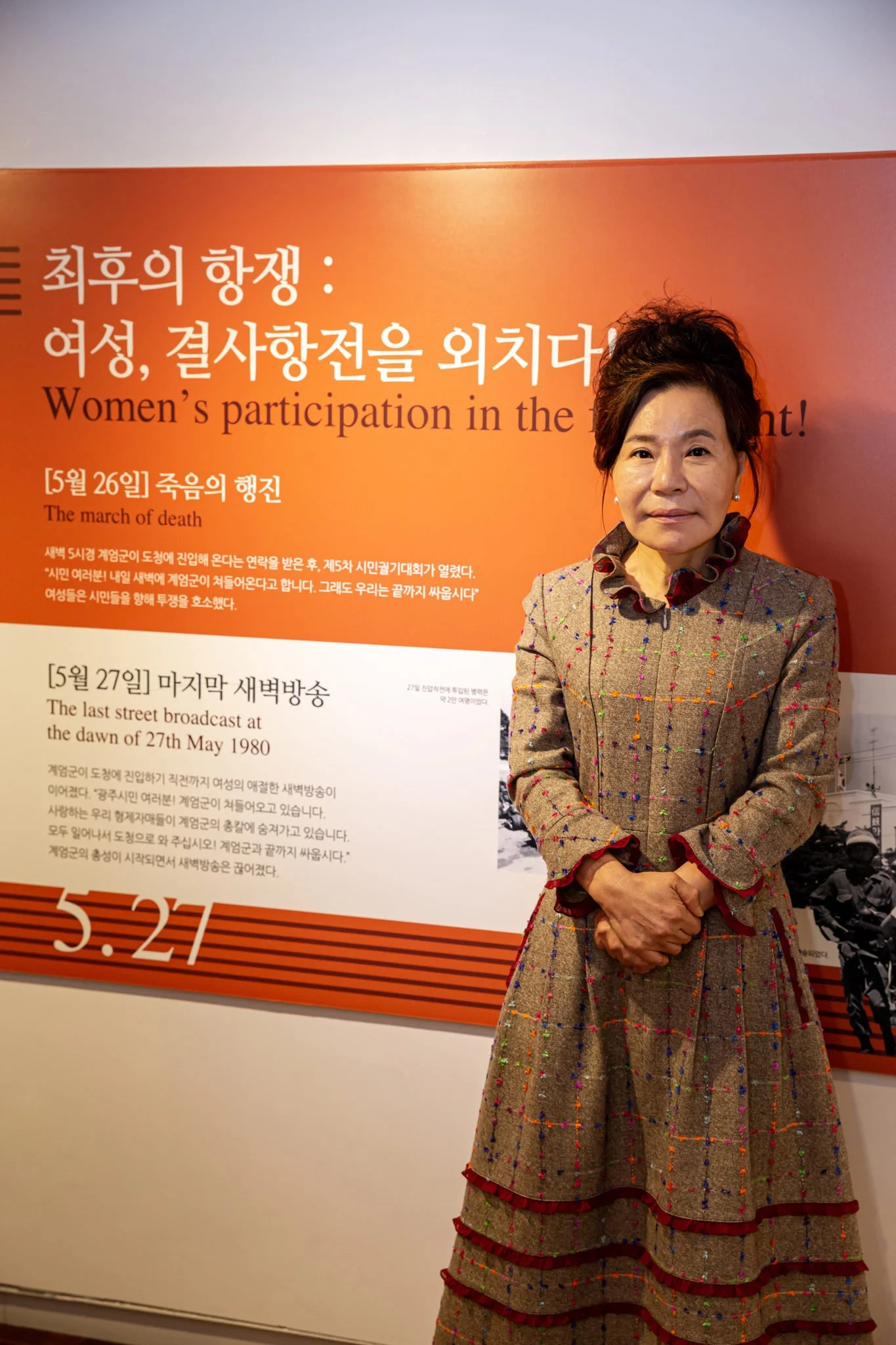
Park Young Soon.
“Conservative parties are still distorting the May 18 events over several issues, including that the uprising was a conspiracy and an organized protest against the military government, and that the protesters were spies brought down from North Korea, but all of these are obvious lies. The reason why the May 18 pro-democracy movement seemed to be a series of democratization protests and have continuity is that there had been demonstrations and protests taking place intermittently against the policies that suppressed Gwangju at the time. Also, the rumor that the uprising was instigated by North Korean spies is absurd because almost every citizen of Gwangju participated in the fight and sacrificed themselves. It was only a continuation of unrest due to the situation of the times, a series of pro-democracy protests that took place before May 18. It was a pro-democracy movement to defend Gwangju against the martial law troops who ruthlessly slaughtered innocent citizens.”
“I think all Gwangju citizens deserve respect – not only those who fought in front of the Provincial Office but all those who had helped in the movement, including women who donated blood and made rice balls for the protesters, and those who made and distributed masks – all the citizens of Gwangju who helped in the pro-democracy movement.”
“Forty years after the event, people can still easily find distorted accounts on the internet. However, people do not think that even this freedom of speech can be enjoyed by the nation’s democratization. Had it not been for Gwangju’s May pro-democracy movement in 1980, there would have been no democratic society like we have today. I hope that young people are aware of the Gwangju Democratic Uprising with factual information and remember this heartbreaking incident in which innocent citizens were beaten and slaughtered by the military of their nation.”
Jeong Hyeon-ae
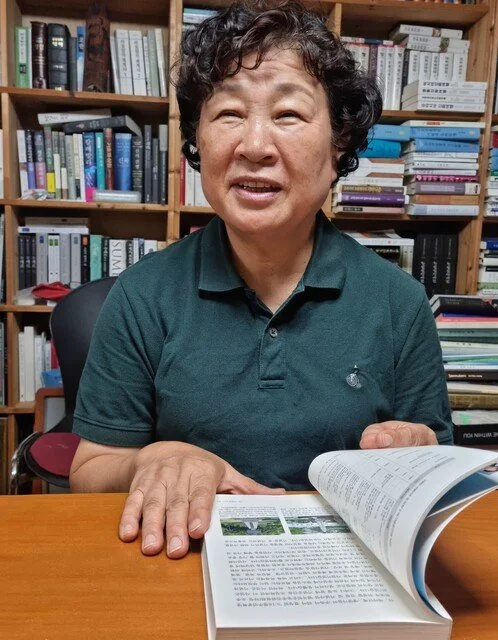
Jeong Hyeon Ae, director of Gwangju May Mothers’ house.
Jeong Hyeon-ae had been put in jail at the Sangmudae Army Compound for her participation in the Uprising. She said, “Even though women’s contribution was 49%, their suffering and hardship has been regarded as nothing more than trivial because they weren’t carrying guns like the men in the citizens’ army. We’re going to make an effort to restore the historical facts not only about women’s suffering but also of their resistance efforts during the Gwangju Uprising.”
Jeong Hyeon Ae married her husband Kim Sang Yoon who was the owner of Nokdu bookstore. Her husband opened the bookstore in 1977 to circulate the books which were banned by the Park Chung Hee’s Yusin Government. Kim was already expelled from college due to his student protest activities. In May of 1980, Jeong Hyeon Ae and Kim Sang Yoon allowed the students to gather at the bookstore to plan and organize the protests. The bookstore served as a central space for student protesters to produce leaflets and posters against the Chun Doo Hwan dictatorship during and after the Uprising. On May 17, 1980, Jeong’s husband was arrested and imprisoned. Jeong continued to support the protestors and joined in feeding those gathered in the square. She was present at the Provincial Office until the day before the Uprising was violently halted by the army. She was arrested and imprisoned, and says that had she not been, she likely would have died with those who stayed at the Provincial Office to the end. The book store was shut in 1981 after crackdowns on student protesters and she was fired from her teaching position at a school. Jeong served as a councilwoman in Gwangju and she serves as the director of the May Mother’s House. She even once faced off directly with Chun Doo Hwan, demanding he release the prisoners still held years after the Uprising. Today, she continues to share about the legacy of the Gwangju Uprising and in 2021, she and her husband were interviewed by the documentary team behind 그리다 (Keurida).
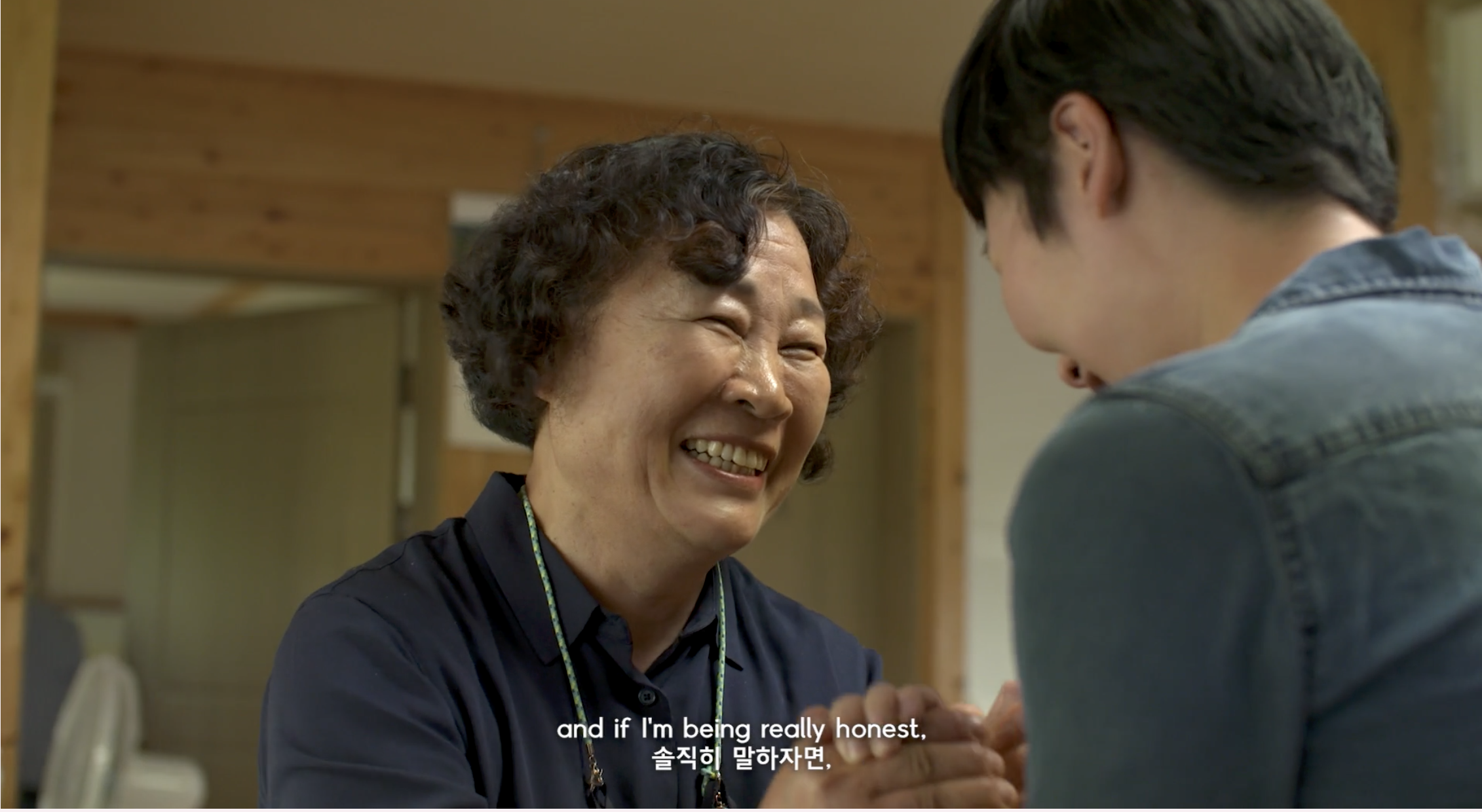
Jeong Hyeon Ae during an interview with Cleo Gray as part of the on-going documentary project 그리다 (Keurida) from Adventure We Can. KCCNYC serves as the impact partner for the documentary.
Others
Other women have slowly begun to tell their stories. Jeon Chun-sim, known as Jeon Ok-ju at the time of the Uprising, took to the stage in 2018 to tell her story about being a street broadcaster and imprisoned and tortured. She sat proudly in the front row at the 2018 memorial service for the Uprising, which is a sign of change.
Women’s Social Roles After the Uprising
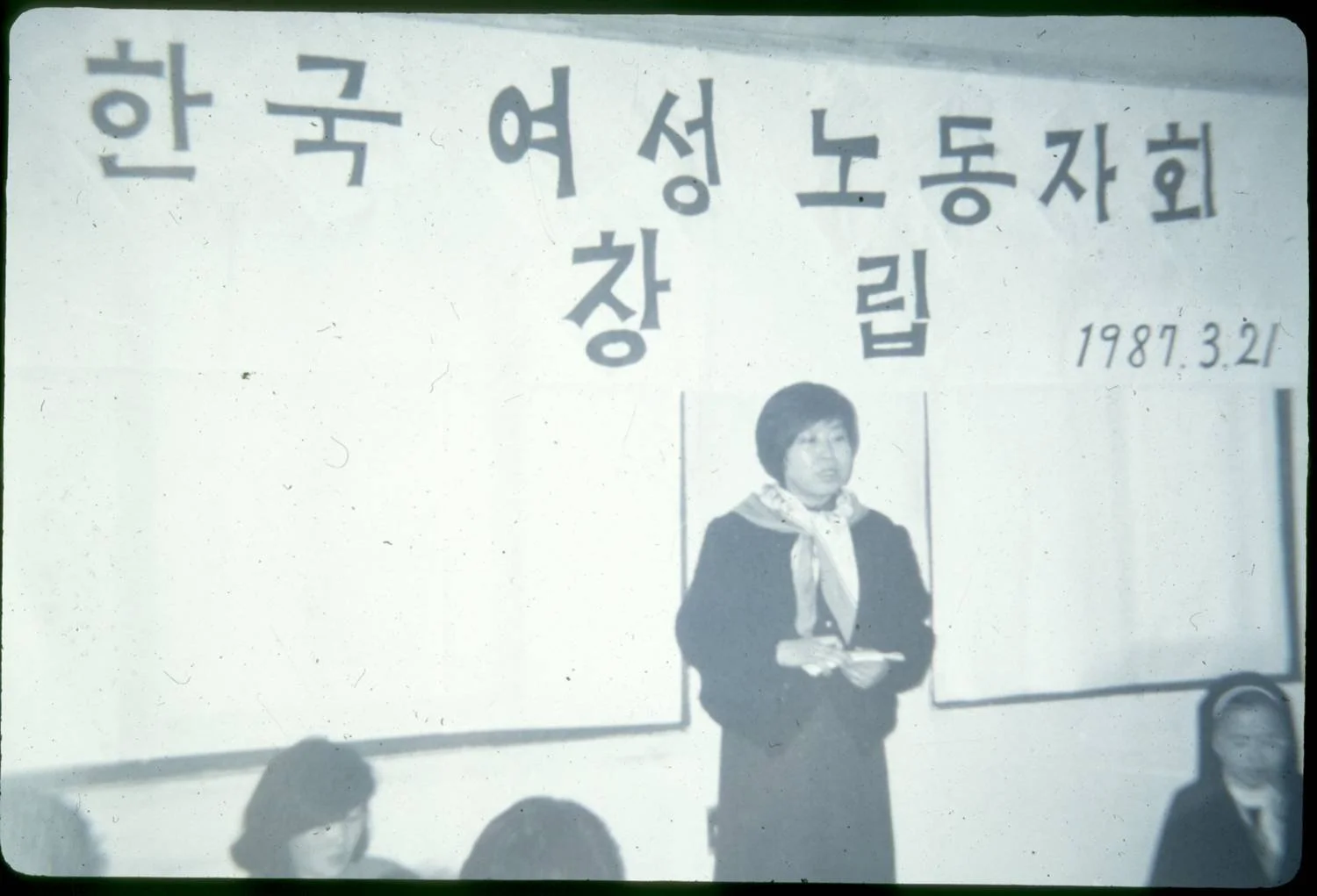
A picture taken at KWWA’s first meeting.
After the Uprising, the government made it illegal to talk about it. People who were praying in churches and mentioned out loud what had happened in their prayers were arrested, including a priest. Women who participated in the Uprising and were arrested went silent, after they were released. Women who were witnesses to what happened were forced into silence by the government. The entire city of Gwangju was silenced.
The Gwangju Uprising and the massacre were the catalysts that continued pushing for true democracy in South Korea, which finally came about in 1987. Women’s roles in organizing for change became more important from 1980 forward, even though their general roles, compared to their male counterparts, were slow to change. Women’s organizations grew. Women’s rights and women’s equality were not a topic that was discussed earlier, but international feminist movements brought pressure to South Korea for gender equality, especially when the United Nations declared the 1980s the Decade of Women.
Women’s organizations such as the KWWA (Korea Women Workers’ Association) were established to address women-specific issues in labor. Women took on the mantel of Minjung Theology (the pre-cursor to Liberation Theology) to talk about their oppressed status.
However, progress in highlighting women’s equality has been very slow to advance. Old Confucian concepts of women’s inferiority and roles have been very hard to die out. Men’s views of women as inferior have also be very difficult to change.
Recognition of Sexual Abuse by the Military
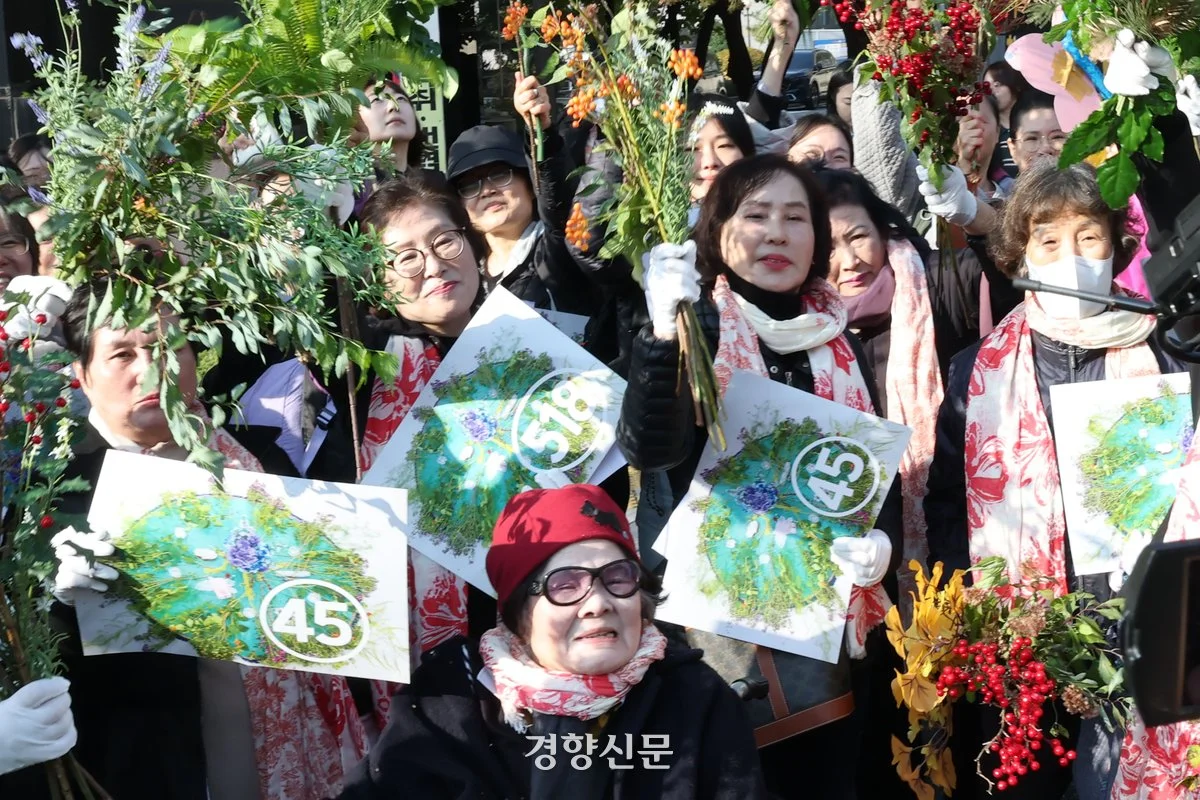
Yeolmae is a nonprofit organization for victims of sexual violence during 5.18
The rape of individual women and the gang rapes that took place by the military during the Uprising were only recognized in 2018. Inspired by the #MeToo movement, women who had experienced sexual violence during the Uprising decided to speak out. A joint investigation by the National Human Rights Commission of Korea and the Ministry of National Defense was begun.
Women have confessed that the mark of the violence, given by those who knew what had happened to them, was worse than the violence itself. Having to live in silence for almost 30 years brought trauma-related depression and caused a number of women to end their lives.
A 23-year-old was apprehended on Geumnam-ro on her way home from work and subjected to sexual violence and sexual torture in the basement facilities of Sangmu and the Defense Security Command. Another woman, three months pregnant at the time, was forced to undress and was sexually assaulted by martial law soldiers. These weren’t protesters nor armed combatants. They were ordinary women living ordinary lives that were grabbed on the street.
This year, 2026, the survivors of sexual violence during the Uprising established a nonprofit organization. Its name is Yeolmae – meaning fruit, symbolizing the bearing of fruit after 45 years. It symbolizes the birth of human rights for women who have suffered sexual violence by the state in South Korea. Their message is one of solidarity with women throughout modern Korean history who have suffered similar violence.
Kim Gyoungrae of the Gwangju Foundation for Women and Family said last year:
“Historical records are influenced by power structures. In history written from the perspective of the privileged – centering on vested interests, the center, and men – the stories of marginalized groups, including women and regions, have often been excluded. Recording history from the ground up, such as women’s history and local history, is essential for establishing a balanced historical perspective and completing the full picture of the past. Specifically, documenting women’s activities in the democratization movement recognizes them as historical agents and helps future generations inherit a just view of history.”
Conclusions
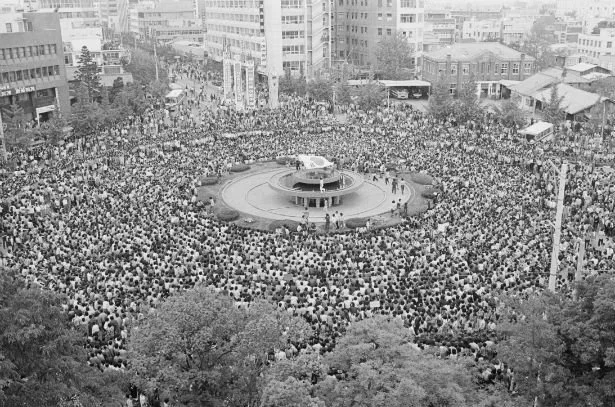
May of Gwangju will be always remembered and celebrated as the heart of Korean democracy.
The history of the Gwangju Uprising is still stained by lies told by the government of Chun Doo-hwan, repeated in the US and perpetuated by subsequent South Korean governments and political parties. The history of women present and involved in the Uprising is further stained by the societal, interwoven and underlying Confucian beliefs that continue to dictate women’s place in Korea. Like I learned when I was young, history is written by the victor and is almost always written by men. That is something that needs to change.
It wasn’t until 1997 that May 18 was celebrated as a National Memorial Day. It wasn’t until 2017 that the government announced it would re-open investigations into the role of the government in suppressing the Uprising. In 2020, an independent May 18 Democratization Movement Truth Commission was set up. It was also in 2020 that a law was passed making it illegal to make false claims about the Uprising. This was forty years after the incident. With the additional shame placed on women’s experiences, it is not surprising that more women have not felt comfortable to come forward. I sincerely hope that the women who lived through the Uprising can feel safe to tell their stories, especially while those whose lives were turned upside down are still alive to give witness.
Additional Acknowledgements
Thank you to Han Kang for her Nobel Prize for Literature winning novel Human Acts that brings the Gwangju Uprising emotionally into our hearts.
The May 18 Democratic Uprising by The May 18 Memorial Foundation
Gwangju Diary - Beyond Death, Beyond the Darkness of the Age by Lee Jae-eui
The Suffered, the Un-represented, Yet Still Protesting: The Cinematic Un-representations of the Bereaved Mothers in post-Kwangju May Uprising Movements by Gooyong Kim
Women and Social Change in South and North Korea by Kyung Ae Park
Gender Politics & Security in Korea by Richa Moni Gogoi
South Korean Women Workers’ Labor Resistance in the Era of Export-Oriented Industrialization, 1970-1980 by Kim Mikyoung
Confucianism and China’s Victims of SGBV by Caroline Seil
Korean Perceptions of Chastity, Gender Roles, and Libido; From Kisaengs to the Twenty First Century by Katrina Maynes
Roles of Gender in the Making of Modern Korean Society: Feminist Scholarship Perspective by Suray Agung Nugroho1
Testimonies:
https://13thgwangjubiennale.org/minds-rising/jeong/
https://english.hani.co.kr/arti/english_edition/e_national/931672.html
https://gwangjunewsgic.com/features/may-18/martha-huntley/
https://gwangjunewsgic.com/features/may-18/may-18-interviews/
Further Reading:
https://miri518.or.kr/eng/index.do
https://storymaps.arcgis.com/stories/175d8a3368224eae804c76abdcc09371
https://english.hani.co.kr/arti/english_edition/e_national/845376
https://www.bbc.com/news/world-asia-46123548
https://www.koreaherald.com/article/10719074
https://www.koreaherald.com/article/1825228
https://en.yna.co.kr/view/AEN20181031003000315
https://gwangjunewsgic.com/uncategorized/breaking-the-silence-the-birth-of-yeolmae/
https://gwangjunewsgic.com/features/memory-voices-and-visibility-a-conversation-with-kim-gyoungrae/
https://www.straitstimes.com/asia/east-asia/trauma-of-south-koreas-gwangju-uprising-lingers-on
https://english.hani.co.kr/arti/english_edition/e_national/931672.html
https://www.ucanews.com/news/south-koreas-gwangju-women-long-forgotten/84094
https://www.bbc.com/news/world-asia-46123548
https://www.womennews.co.kr/news/articleView.html?idxno=170258
https://www.coreaverse.com/2025/11/the-gwangju-uprising-truth-and-memory.html
https://gwangjunewsgic.com/features/memory-voices-and-visibility-a-conversation-with-kim-gyoungrae/
https://www.hani.co.kr/arti/society/society_general/860532.html
https://www.sisajournal.com/news/articleView.html?idxno=110724