
THIS MONTH IN KOREAN HISTORY - April 2026
DISABILITY RIGHTS IN KOREA
By Sharon Stern
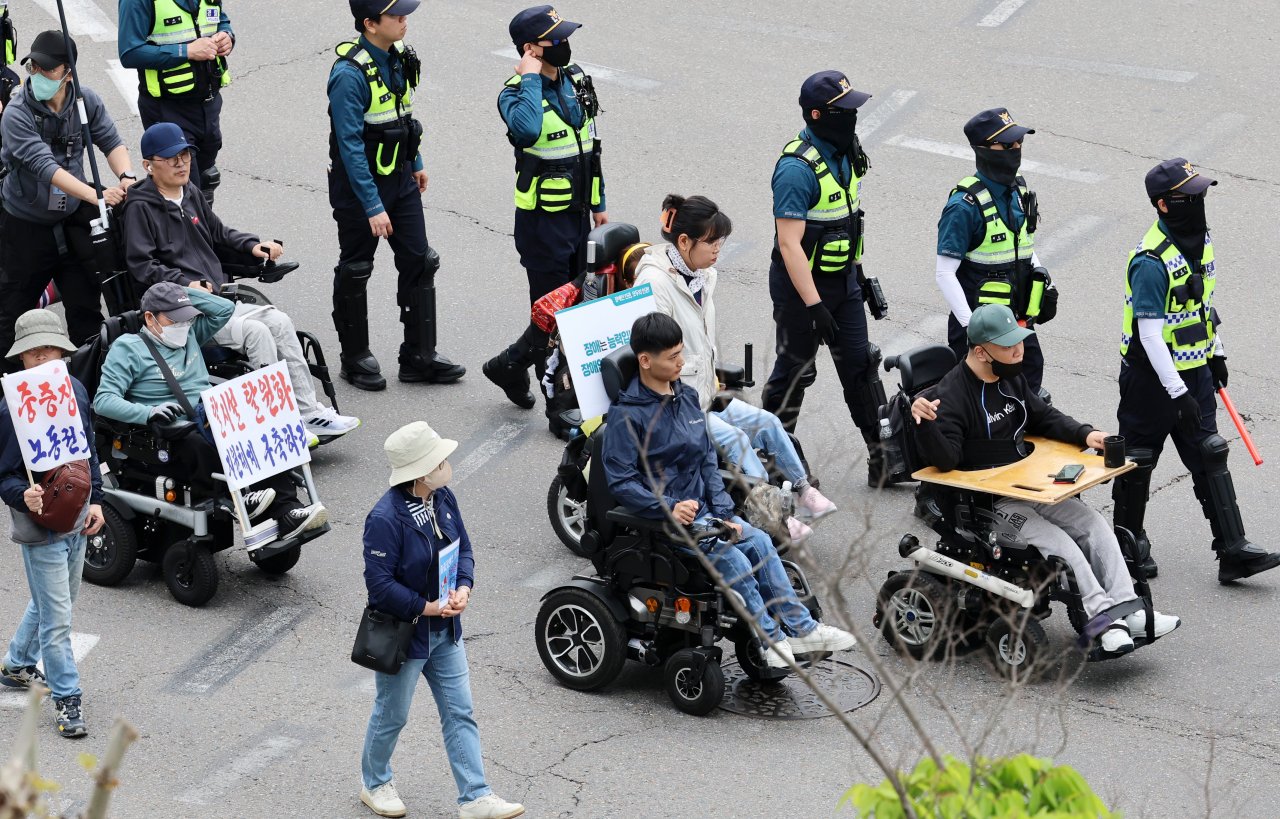
SADD (Solidarity Against Discrimination Against Disability) Gwangju branch protesting for Disability Rights.
April 20th is the Day for People with Disabilities in South Korea. People with disabilities have been discriminated against across the globe for millennia. Modern definitions that define disability have somewhat changed our perspectives and we now understand that a large percentage of the population has some level of some sort of disability. Because disabilities vary so broadly, depending on whether they are physical, mental, developmental or a combination of these, it is challenging to talk about disabilities as a single issue. Every culture has had its history in abusing disabled persons. The history of disability rights in South Korea has its own unique twists. We will explore some of this history as we try to understand the challenges facing South Koreans with disabilities.
History
Every culture has underlying attitudes, philosophies, theologies that guide and shape it. History, tradition and interpretation embed these into the way we look at the world and, consequently, the way we treat other people.
Neo-Confucianism and Buddhism
the Three Kingdoms of Korea period (around 500 BC to 668 AD), contain stories about disabled people. The interpretations give a mix of attitudes towards disabilities. They say, for example, that the king, and consequently society in general, believed it necessary to feed and take care of those that could not take care of themselves, including those physically or mentally unable to do so. Such stories and texts were used to educate rulers on how to rule virtuously.
Buddhism dominated Korea in the late Three Kingdoms period and Korean Buddhism is a unique branch of Buddhism. Both of these ancient texts simultaneously indicate that physical and mental disability are the result of karma – an effect caused by previous misdeeds – but also tell stories of disabled people helping able-bodied people find enlightenment by challenging them. Stories of filial piety tell of children sacrificing themselves for disabled parents and the power of Buddhism restoring their parents to a state of able-bodiness are also included.
Neo-Confucianism blends classic Confucian thought with aspects of Buddhism. Neo-Confucianism is what dominated Korean social structure during the Joseon Dynasty. In order for there to be balance between heaven and earth, everyone had to correctly and faithfully play their designated role. If society was out of balance, the energy of the world was out of balance and could cause widespread disease, drought, etc. Embedded in this thought is the interpretation that anyone that is not a “competent person” is disrupting society and therefore the balance of all of life. A competent person is defined as having a good body, the ability to communicate, literacy, and judgment, which would disqualify many disabled people.
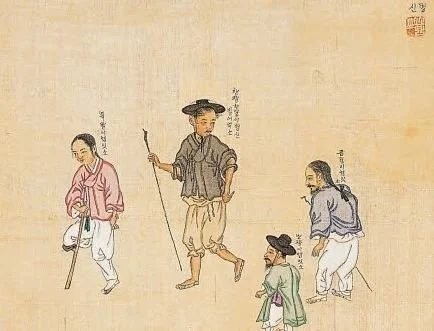
Painting from late Joseon period by Kim Joon Geun depicting people with disability. The piece is titled Byeongshin (병신).
In addition, each person embodies all of the essential elements: water, fire, earth, metal, and wood. Illness of any kind is a result of one of these elements being out of balance. People with disabilities were referred to as ill body (병신) or ill person (병자), suggesting that disability was something that could and should be cured. It was also believed that disability could be caused by the sins of ancestors, geomantic misplaced houses or graves, ghosts, etc. Negative associations against disabled people were strong.
Filial obedience is one of the three fundamental principles of Korean Neo-Confucianism. The balance of family life is crucial to society’s structure. Disabled children are not able to help and support their parents and the family. Anything, including disability, disrupting that balance brings shame to the family, which then brings shame to society. Disability became something to be hidden and not talked about and was the source of deep shame.
Disability terminology changed during Japanese occupation. The term “deformed person” (불구자) was used and meant someone not able to contribute to the benefit of the Empire because of physical or mental disability. Disability was seen as a social problem that pulled society down. Jobs that had been held by disabled people during the Joseon Dynasty, such as fortunetelling and service in Buddhist temples were outlawed, pushing disabled people further into poverty and marginalization. The Japanese government essentially provided the excuse for people with disabilities to be dehumanized.
Modern History
After Korea’s liberation from occupation, all of these philosophies and social stigmas remained. Resources were not available for health care in general and even more-so for people with disabilities. Only 1% of the budget went to health care of any kind during the Korean War.
Hansen’s Disease
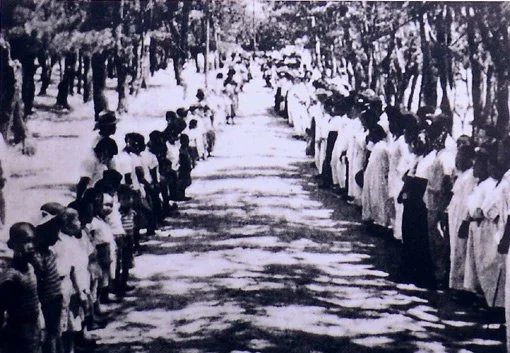
Patients with Hansen Disease living in Sorok-do were forcefully separated from their children. Children were only able to see their parents once a month, until they turned 15 years old. The children were lined up on the left, and the parents were lined up on the right to watch the children.
Hansen’s Disease used to be referred to as leprosy and it has a history in Korea stretching back to around 1875. Hansen’s Disease is a chronic, infectious disease that can leave people disfigured, blind and with muscle weakness. In 1916, after the Japanese occupied Korea, a hospital was established on Sorok Island or Sorok-do, off the south of the Korean peninsula, and people with the disease were exiled and interned there. At its peak, the island housed around 6,000 people with the disease, though the island as a whole housed many more than that. Patients’ treatment on the island was horrific and the subject for another article, but it should be noted that patients were not allowed to leave during their lifetime. After liberation, the newly formed South Korean government maintained a policy of quarantine and segregation and that policy was in place until 1963, though the stigma against patients lasted much longer than that.
A bridge was built to Sorok-do in 2009, relieving the islands isolation. The hospital building was rebuilt, but still treats patients with Hansen’s Disease to this day. Patients now, however, are treated and then can leave. Before 2009, patients could not board the ferry without a doctor’s permission. Because of their long suffering and life-long trauma in being isolated, many patients remained on the island after 2009, because life there was the only life they knew. Discrimination, isolation and abuse of people disfigured by Hansen’s Disease has been difficult to change in South Korea, despite modern understanding of the disease and its treatment.
1986 Seoul Asian Games and 1988 Seoul Olympics
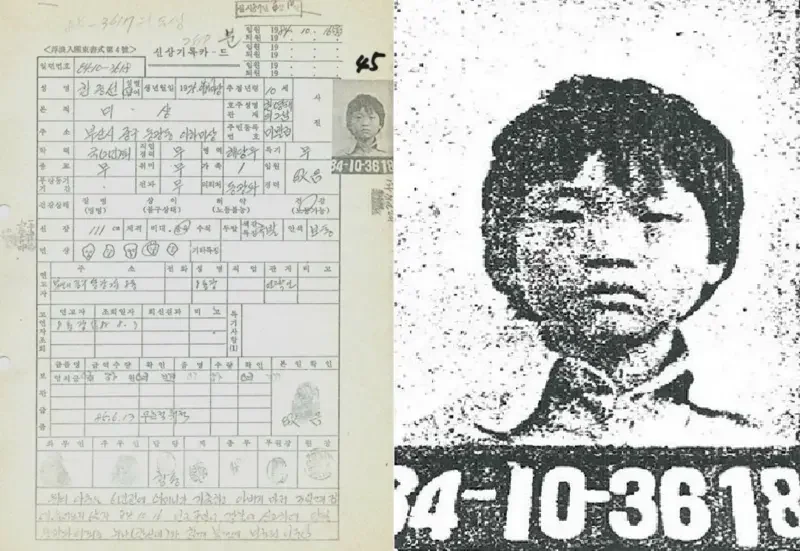
Personal Record from Brother’s Home, which shows that even chidren were taken to be indentured.
Ahead of the public spotlight created by the international sporting events of the 1986 Asian Games and 1988 Olympics, both held in Seoul, the government believed that disabled persons would bring national shame to the country if they were seen by the rest of the world. Disabled people were rounded up and forced into institutions, but they were also made to do forced labor and suffered other abuses. Many were not allowed to leave the institutions after the Olympics. Even though the 1981 Welfare Act had been enacted, it did not protect people from these abuses.
Many people were sent to an institution called the Brothers’ Home, which also contained unhoused people, children and student protesters. It was an internment and labor camp that also had factories on site. The Truth and Reconciliation Commission determined that at least 657 people died there and that widespread abuses of all kinds were prevalent. The Brothers’ Home was a big source of child adoptees to the US and European countries.
Disability Hierarchy
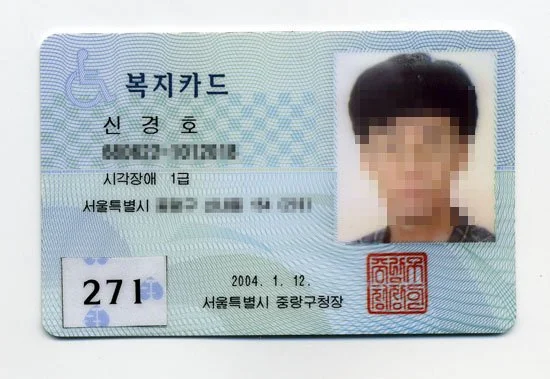
Korea’s disability welfare card showing “vision impairment Grade 1” Photo Credit Shin Kyung Ho
In 1981, South Korean enacted the Welfare Act for the Mentally and Physically Disabled. There were originally six hierarchical grades of disability defined by the act, each graded by its severity: Grade 1 was the most severe kind of disability and Grade 6 was the mildest. In other words, the type and severity of disability was completely legally defined. The disability rating was determined as a percentage reflecting the ratio between the loss of function due to impairment and function before loss. The original Grades 1-6 corresponded to ratios greater than 85%, 75-84%, 60-74%, 45-59%, 35-44%, and 25-34%, respectively. Assistance, institutionalization and other treatments for disabilities were determined by this grading system.
In 1988, South Korea created a registry for disabled persons. Registration was required to receive any type of assistance. In order to register, a number of legal steps were required, including a certificate from a qualified physician specialist. Both the grading system and the registry seemed to create as much discrimination as it relieved. It forced disable people to conform to policy based on strict definition rather than having policy meet the needs of the disabled.
The definitions of disability grades were modified several times after 1981 and finally include fifteen grades. The national registry is also tied to the national health system. In 2019, however, the grading system was finally abolished. Disabilities are still determined to be severe, moderate or mild, but include assessment of daily living activities and social environment.
Mental Health Issues
It wasn’t until 1961 that a dedicated hospital for mental health patients was inaugurated. Institutionalization for mental health issues is still the norm and institutions have been well-documented for abusing patients. Mental health is still very much a taboo subject in Korea. The shift from institutionalization to community-based care is moving very slowly.
In 2016, South Korea opened the National Center for Mental Health, which provides outpatient and inpatient care, research and in 2018 added the National Center for Disaster and Trauma, focusing specifically on the mental health issues created by trauma. The NCDT provides planning and crisis services during and after disasters, as well as long-term trauma support.
Developmental Disabilities
Similar to many countries, South Korea has a history of institutionalization, forced sterilization and isolation of people with developmental disabilities. Legislation, however, is beginning to protect this vulnerable group.
In 2015, the Act on Support for Persons with Developmental Disabilities was enacted, recognizing the distinction between physical disabilities and social and communication challenges of those with developmental disabilities. Three years later Comprehensive Plan for Lifelong Care for People with Developmental Disabilities was announced, targeting life-long care for those with developmental disabilities.
In the job market, the 2021 employment rate for people with developmental disabilities was 28% compared to 35% for all people with disabilities and 60% for all Korean people. Developmentally disabled people also earn significantly less than workers with physical disabilities. Public perception and stigma are still the biggest barriers blocking progress for people with developmental disabilities.
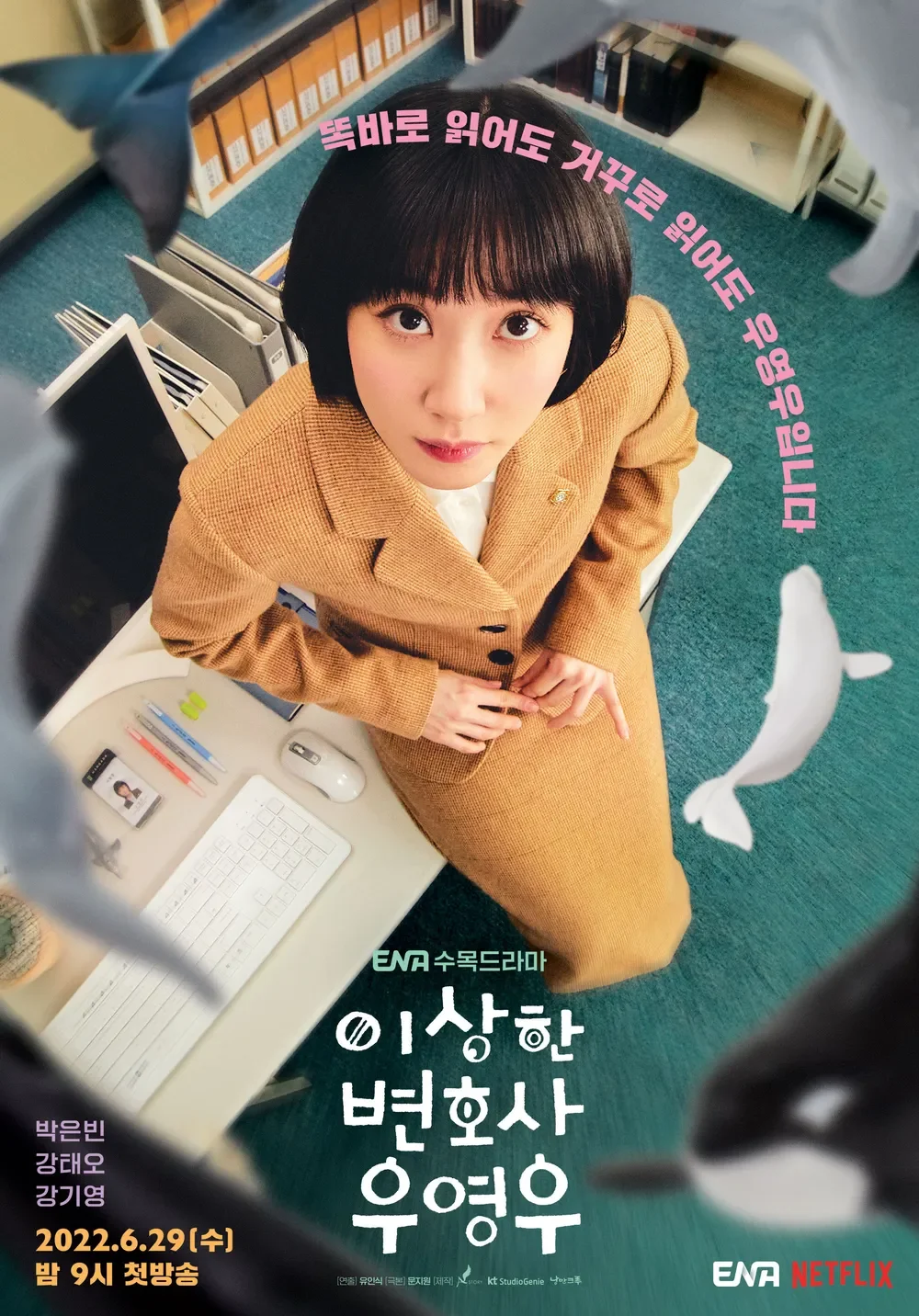
Recent international successes of K-dramas with characters that have developmental disabilities such as Extraordinary Attorney Woo and Our Blues were surprising inside of South Korea, but brought focus on the issue and its social stigmas. If these shows had been made uniquely for a Korean audience, they probably would not have garnered as much attention or might not have been made at all. Even the title of the Attorney Woo series has more of a stigma in Korean, where the adjective is weird or strange, not extraordinary.
The Anti-Discrimination Against and Remedies for Persons with Disabilities Act
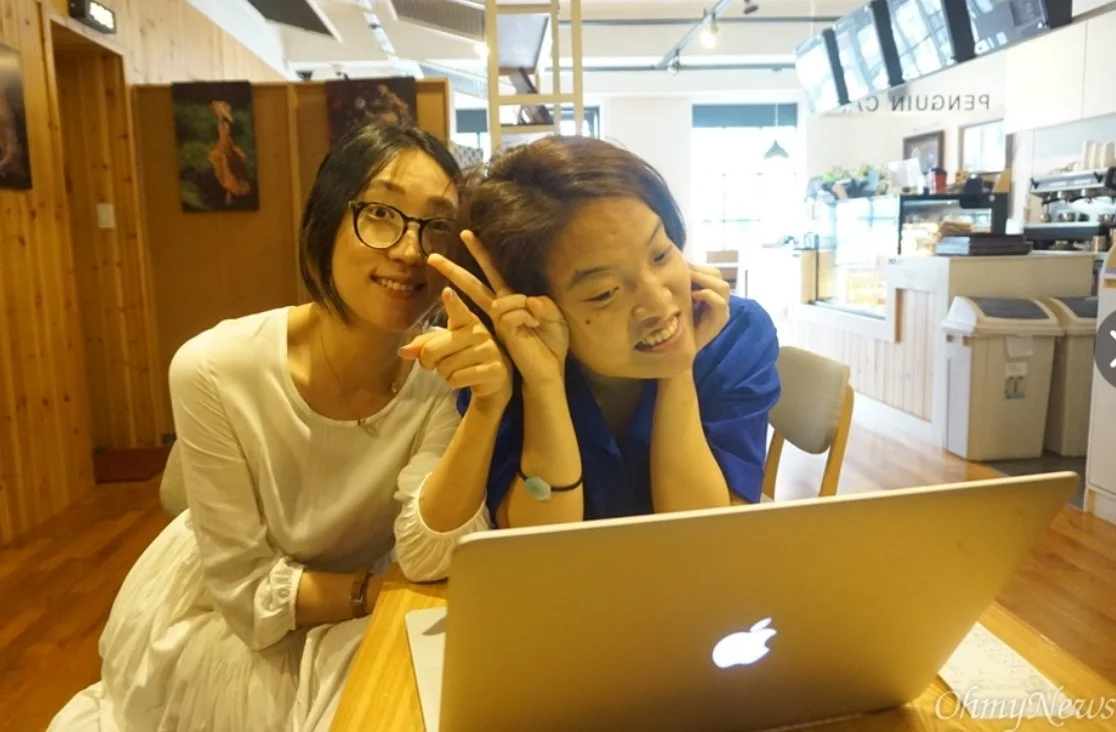
Former National Assembly Woman Jang Hye Young with her sister Jang Hye Jung. Assembly Woman Jang was a vocal supporter of the bill for Comprehensive Anti Discrimination Law.
The Anti-Discrimination Against and Remedies for Persons with Disabilities Act was enacted on April 10, 2007 and its text goes quite far in defining both temporary and permanent disabilities and the illegality to discriminate in the workplace, equal access to services, freedom from harassment, the right to self-determination, access to education and healthcare, etc.
Despite this, statistics show that 30% of households with at least one disabled person live in poverty in South Korea. Access to employment and education are still not universally available. Recent governmental plans to assure that all children have equal access to education are facing challenges in implementation. The definitions of inclusion when interpreted legally mean that special education students can be isolated from the general population in separate institutions. Lack of teacher training and understanding in a highly competitive education environment impedes further integration of students with disabilities.
Employers are required to hire a minimum of 3.4% of their workforce with disabilities. They are required to make modifications in workspaces and work hours. South Korea has a Korea Employment Agency for the Disabled (KEAD). However, lack of protection for sick time effects disabled employees disproportionally. There is a push to enact national legislation for sick time in work places.
There are a few companies making a concerted effort to employ people with disabilities. Donggubat, a company that makes eco-friendly soaps and personal care items is a good example. Their high-end, luxury products are contracted to upscale business and they are committed to employing people with developmental disabilities.
Employer accommodations for people with disabilities such as wheelchair ramps and accessible toilets still lag behind the legislation trying to increase employment opportunities for disabled people. General social stigmas and ignorance prevent acceptance of people with disabilities in public spaces. Lingering cultural judgements sustain the feeling of shame towards disabilities and encourage families to keep disabled people at home. As South Korea becomes more diverse and as more people from outside go to South Korea to live, the tensions of against stigmas increase, which is a good thing.
Family Support Obligation
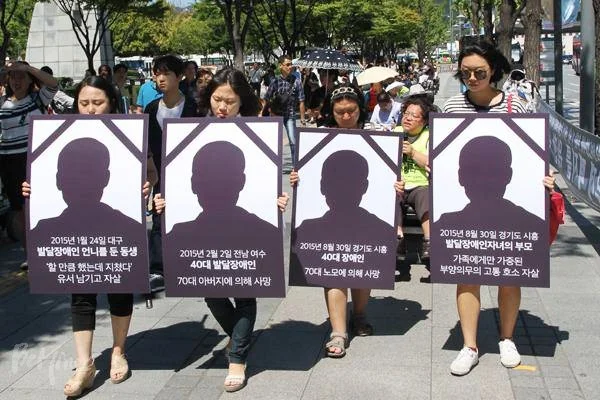
Protesters are commemorating disabled people who either took their own lives, or were killed by their family members who were struggling to take care of them. Photo from 2015 article.
In 2000, the Minister of Health and Welfare passed the National Basic Living Security Act, obligating any disabled person with a family member to be supported by those family members. The supposed intent of the law was to guarantee a basic standard of living for everyone, including the disabled. However, because family members income was used to evaluate whether a disabled person received benefits, many families were left to help their disabled children and relatives on their own, even though caring for them either reduced their ability to work or greatly increased their living costs. The system used the grading scale for disabilities and assumed that disabled persons could be employed and contribute to the system, despite the statistically low availability of jobs for people with disabilities.
At the end of 2025, the calculation to include family support was finally repealed.
Pushback – Disability Rights Activism
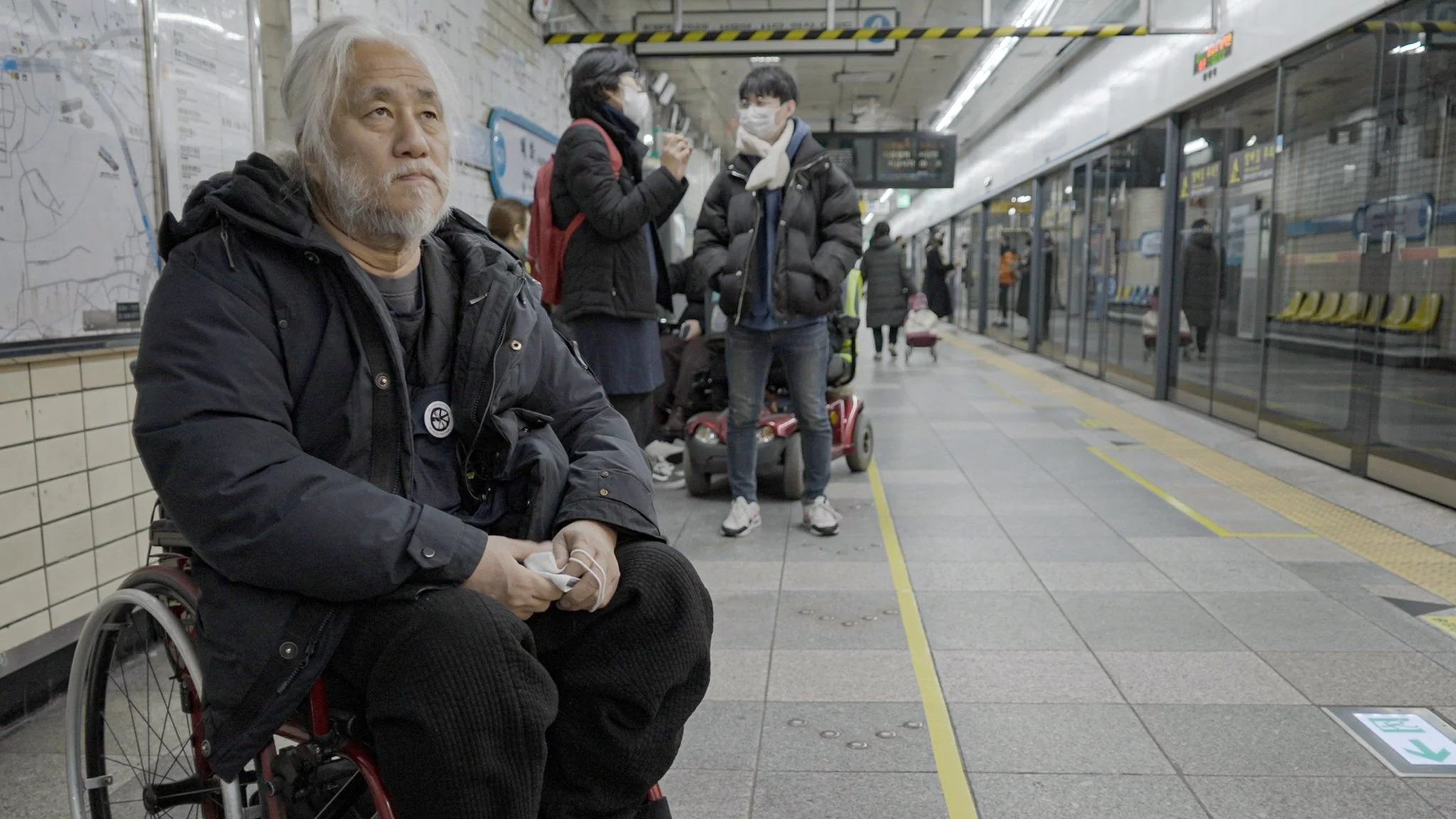
Park Kyung Suk, leader of Solidarity Against Disability Discrimination (SADD)
In 1980, disabled students who had passed the university exam were denied entrance to universities because they were disabled. Disabled people began to organize and demand rights. Groups began to form to push back against cultural biases toward disabilities. It is important to note that South Korea was still ruled by a dictatorship at this time, so protest of any type was dangerous. Groups and their protests continued to grow through the controversy of the 1988 Olympics. In 2001, a disabled person died falling off of the unprotected wheelchair lift at Oido Subway Station. This was when the organization SADD, Solidarity Against Disability Discrimination, started taking their protests to the streets.
SADD’s tactics, which have included blocking busses and subway stations at rush hour, though peaceful, have been heavily criticized by some. Critics say making everyone suffer doesn’t help their cause. Police have responded brutally and callously, arresting and blocking protesters from the subway. SADD argues that having attention drawn to disability access rights through interviews and newspaper articles has not brought change. They are tired of being told to stay home and of unfulfilled promises for equal access. They have proved that consistent protest can bring about change.
A five-year sit-in by SADD against the disability grading system helped bring change. Long protests against the family support obligation system helped bring change. Continued protests for mobility access to subways and busses is beginning to help bring change. SADD understands that maintaining a presence and persistently communicating the need for the rights of the disabled can help bring about greater equality. SADD has acknowledged seeing the beginning of a shift from public pity to understanding that disabled people have rights.
Conclusions
It is sometimes difficult to remember that disability rights are relatively new everywhere in the world. In the US, the Americans with Disabilities Act only came into effect in 1990. Prior to the 1980s, most people with developmental disabilities and mental disorders in the US were permanently institutionalized. Even after institutions began to close, funding for support of disabled people lagged far behind the closing of those institutions.
South Korea only began its path in democracy in 1987. There have been many steps forward in legislation for disability rights since the early 2000s. As with many countries, funding to back up the legislation is lacking, but slowly growing. South Korea ranks well below other developed countries in their financial support of people with disabilities – only .49% of GDP. There are areas of access that are still lacking and the model of institutionalization for certain disabilities is still too prevalent. However, organizations like SADD help everyone understand the issues more clearly and their persistence has helped bring about needed changes.
72.6% of South Koreans have experience discrimination in education, access to public services, employment. Mistakenly created grading systems and forced family financial support have taken away energy and resources that could have brought about faster and more effective changes. Unequal pay for disabled workers is too common. However, the government did create 10,000 new public sector jobs for the disabled in 2018. Reproductive rights for women with disabilities are still met with social judgement.
There is always more that any country can do to protect the rights of the disabled among them. That is certainly true of the United States and it is also true of South Korea. Progress is being made. That needs to be celebrated. More progress needs to be made. The pressure needs to be kept on to see that happen. Change in public perception and acceptance are going to be the key to deep and lasting progress.
References
https://en.wikipedia.org/wiki/Disability_in_South_Korea
https://ssir.org/articles/entry/developmental-disabilities-south-korea
https://www.rdsjournal.org/index.php/journal/article/download/874/2206
https://www.3da.org/post/leprosy-in-korea-the-isolation-sterilization-and-forced-labor
https://borgenproject.org/disability-and-poverty-in-south-korea/
https://www.sciencedirect.com/science/article/pii/S0962629823002056?via%3Dihub
https://www.rdsjournal.org/index.php/journal/article/view/874/2205
https://sk.sagepub.com/ency/edvol/disability/chpt/history-disability-korea#_
https://www.e-epih.org/journal/view.php?doi=10.4178/epih.e2023053
https://hekint.org/2020/12/30/the-sorokdo-national-hospital-of-south-korea/
https://s3.amazonaws.com/reeve-assets-production/South-Korea-Disability-Resources-9-17.pdf
https://www.oecd.org/en/publications/disability-work-and-inclusion-in-korea_bf947f82-en.html
https://english.hani.co.kr/arti/english_edition/english_editorials/1074256.html
https://www.amnesty.org/en/wp-content/uploads/2024/09/ASA2581272024ENGLISH.pdf
https://borgenproject.org/extraordinary-attorney-woo/