THIS MONTH IN KOREAN HISTORY - June 2026
MEMORIAL DAY IN SOUTH KOREA
By Sharon Stern
June 6th is Memorial Day (현충일) in South Korea. We will take a look at its history and meaning.
History
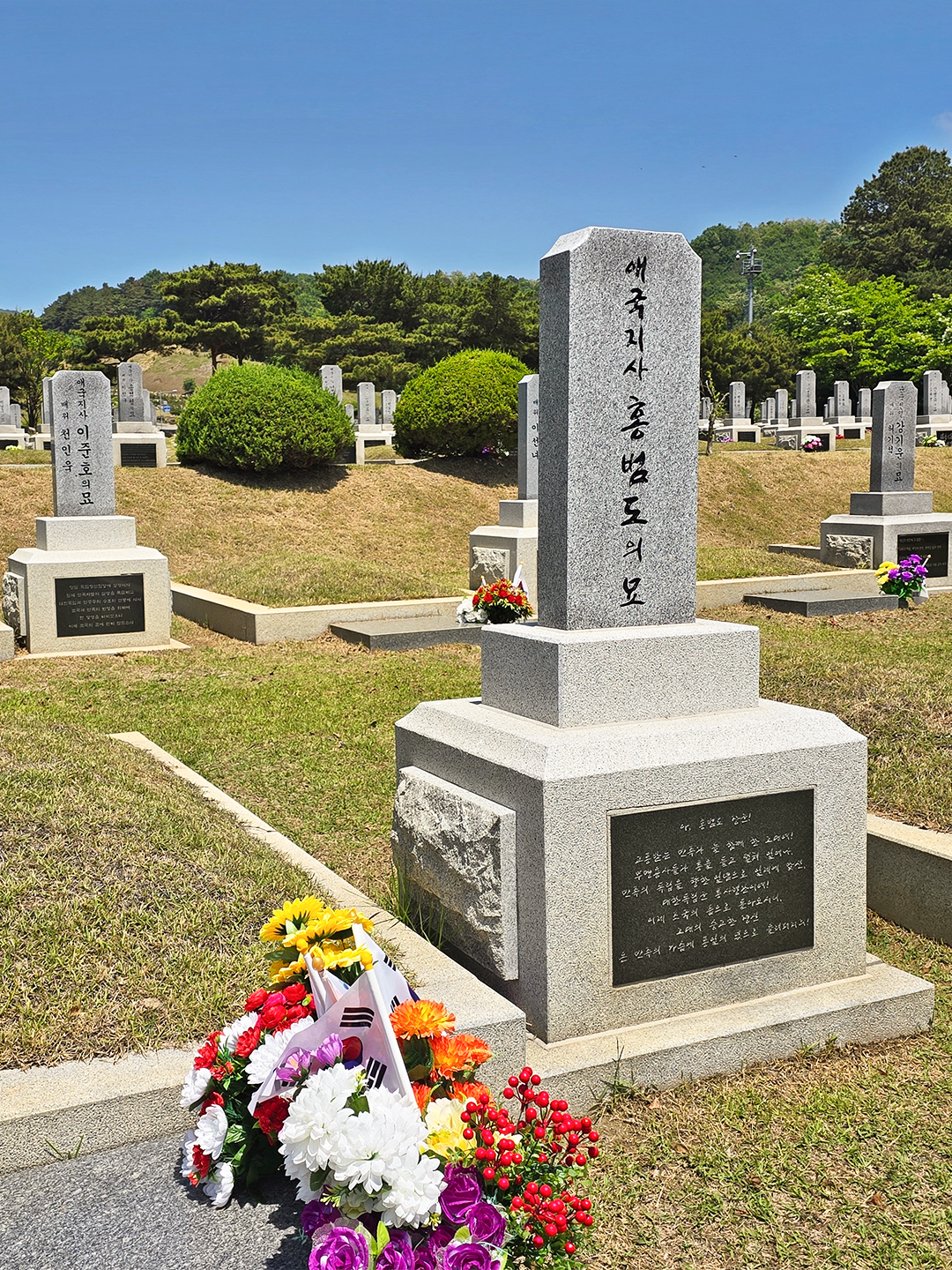
Independence Leader General Hong Beom-do was laid to rest at Daejeon National Cemetery.
There are currently ten countries that observe some type of a Memorial Day to honor the sacrifice and service of members of the country’s armed forces including: South Korea, United States, Britain, France, New Zealand, Australia, Turkey, Nigeria, Italy and Canada. Each country celebrates on a different day – connected with or close to the date of a significant military battle or victory – and in unique ways.
Memorial Day in South Korea was established in 1956. The Korean War had been fought from 1950-1953. South Korea never signed the 1953 Armistice Agreement and even though the war did not officially end, the devastating losses were felt throughout the peninsula. More than three million people died during the war, 50-70% of whom were civilians. It was the bloodiest war of the Cold War era. Its establishment by a controversial (though popular at the time) leader, Syngman Rhee, came right after his re-election in May of 1956. The national observance was a time set aside for citizens to remember the sacrifices of military personnel who had given their lives for the country.
In 1991, the Ministry of Patriots and Veterans Affairs expanded the observance to include all who have given their lives for their country, including pre-Korean War resistance fighters, Koreans in all wars and civil servants, such as police and firefighters.
In 2000, President Moon Jae-in celebrated the 100th anniversary of the victorious Battle of Bong-oh Town (see below) and vowed to repatriate the remains of the leader, Hong Beom-do, of the Korean Independent Army, which was done in 2021 and his remains now rest at Daejeon National Cemetery.
The main celebration for Memorial Day takes place at Seoul National Cemetery at 10 am on June 6th each year, but celebrations are coordinated across the country. At 10 am, a siren sounds across the country. Traffic stops. Everyone stops what they are doing and observes a minute of silence. Celebrations at Seoul National Cemetery are organized by the Ministry of Patriots and Veterans Affairs (MPVA) and presided over by the president. Normally in attendance are the Prime Minister, Speaker of the National Assembly, Chief Justice of the Supreme Court, President of the Constitutional Court and Chairperson of the National Election Commission. Flags around the country are flown at half-staff.
Etymology and Date
Memorial Day in South Korea is known by the term 현충일 (hyeonchungil). Let’s look at what this means:
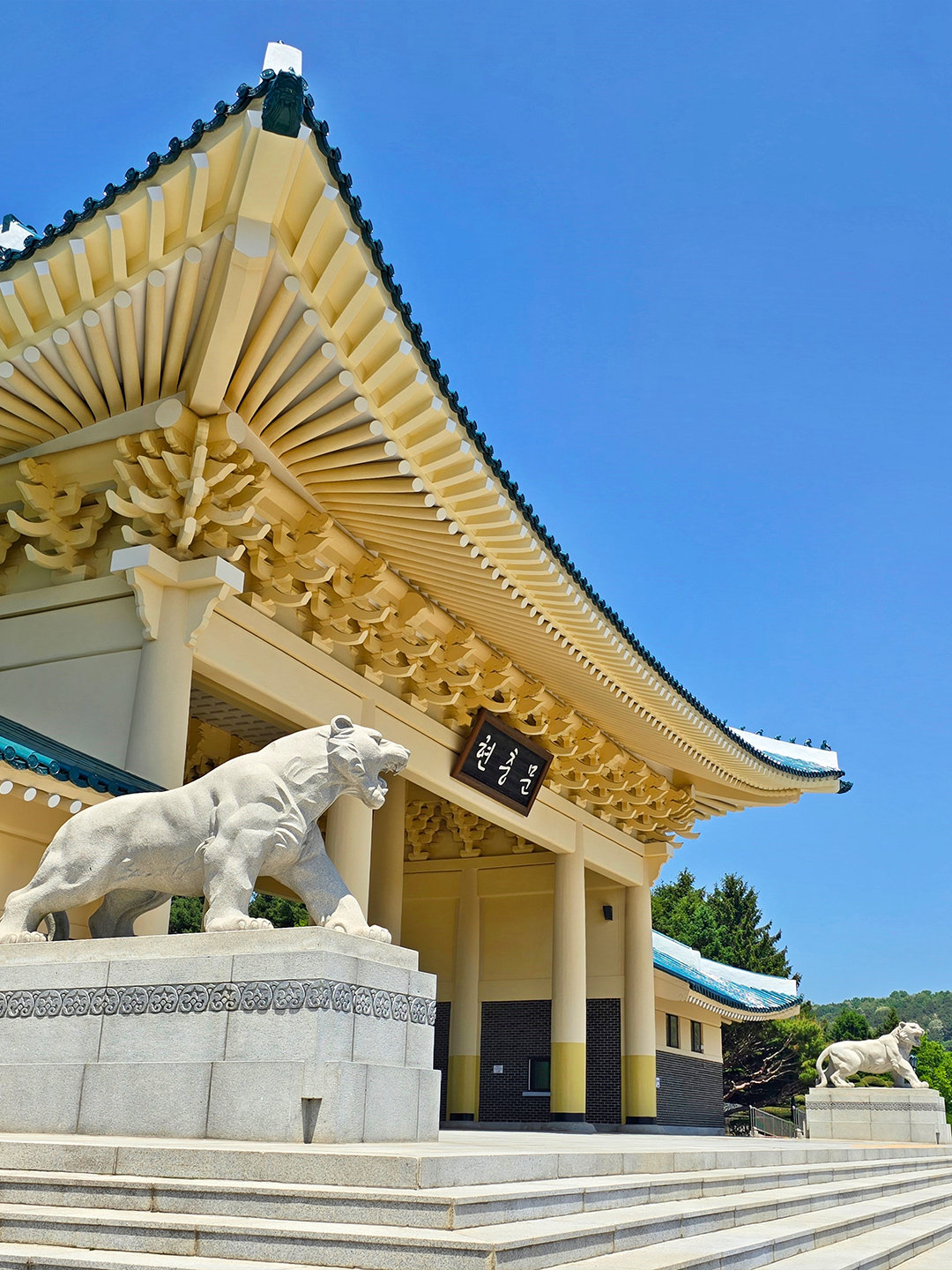
Entrance to Dajeon National Cemetary. The entrance sign reads 현충문, which means the door to showing loyalty.
현: Hyeon (顯): to reveal or show
충:Choong (忠): loyalty/devotion
일: Il (日): day
Put those altogether and the meaning is essentially A Day to Honor Loyalty.
Why June 6th?
To understand the selection of this, specific date, we have to look at calendars used throughout Korea’s history. Korea began using a lunisolar calendar, adopted from China, very early on. Lunar and solar events were both used to create calendars, with time adjustments inserted (like leap years). The calendars were based on the equinoxes and solstices, phases of the moon, movement of the constellations and other celestial events, adjusted by location. There were different calendars used over the course of time, as mathematics and observations evolved. When the influences of European mathematics came to China and surrounding countries at the end of the 17th century, even more adjustments were made. Even after the adoption of the Gregorian calendar for official events in 1896, the lunisolar calendar continues to be referred to and used to calculate dates for holidays such as Chuseok (추석) and Seollal (설날). The yearly calendar is folded into a sexagenary cycle of years (60 years) and it is from these cycles that the zodiac is extracted.
The calendar is broken up into 24 solar terms, which track the position of the sun as well as changing weather. These solar terms are used to determine when the ideal time for planting and harvesting are, but were used for picking dates for weddings, conceiving children and many other important events as well.
Why does any of this matter? Well, June 6th fell on the Mangjong (망종) solar term. Mangjong translates to “Grain in Ear” and was the ideal time to plant bearded crops like rice and barley (called this because the long spikes of grains look like a beard), marking the beginning of summer farming. In ancient Korea, Mangjong was considered a sacred and favorable point in the calendar. During the Goryeo period, fallen soldiers were honored at Mangjong. This tradition continued during the Joseon Dynasty.
Symbolically, connecting the planting of seeds for growth of future food was connected to the fallen soldiers who had planted their lives for the future of the nation. Because the lunisolar calendar and the Gregorian calendar to not perfectly align at the same point every year, selecting a specific Gregorian date to celebrate every year was a bit of a compromise between calendars. Mangjong falls on the 6th day of the 6th month of the lunisolar calendar, but that is almost always on June 6th in the Gregorian calendar.
Korean War
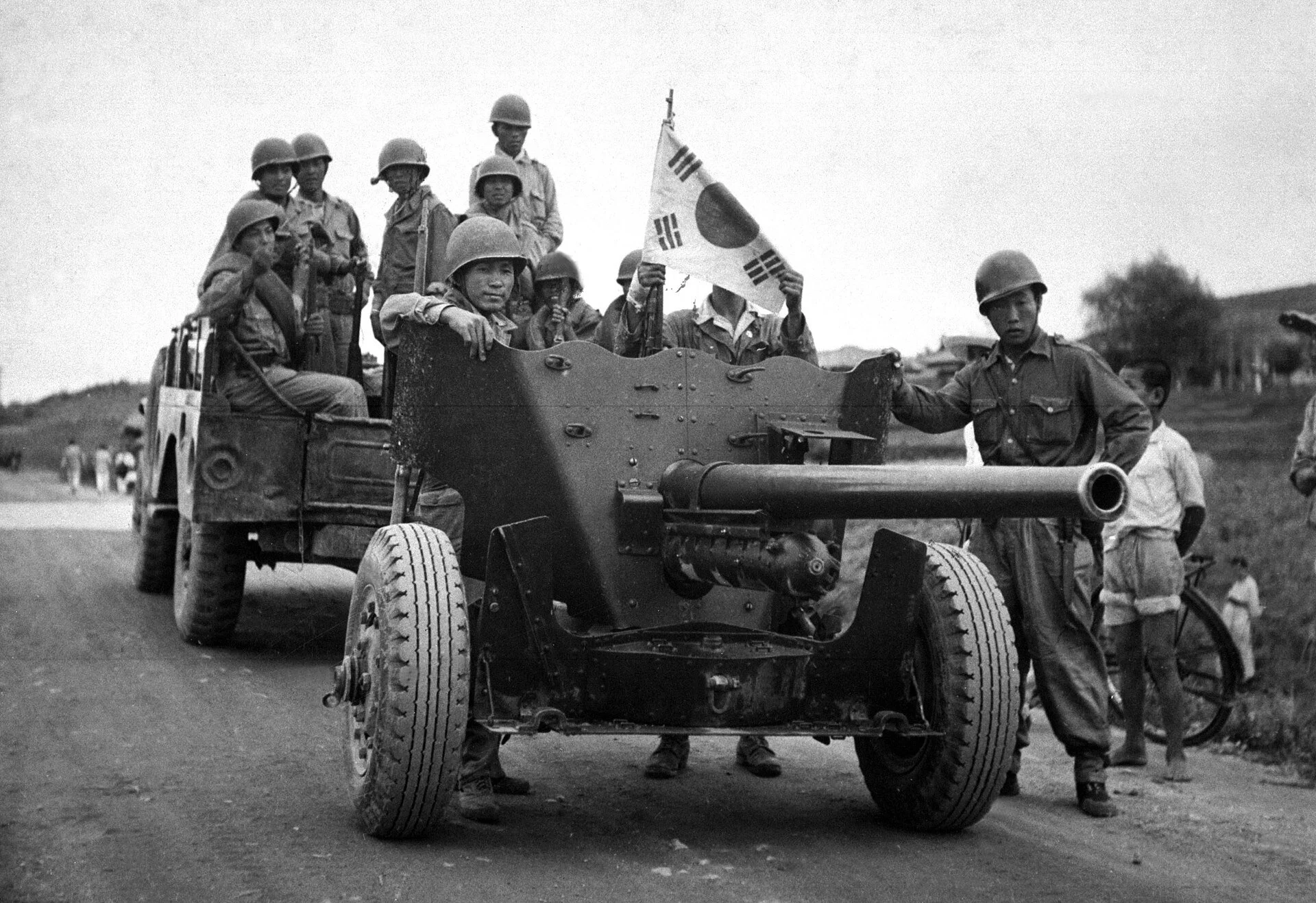
Korean War initiated on June 25, 1950.
The history of the Korean War could take up countless articles and there is no way to do its history justice in a paragraph or two. At the highest level, we know that it completely changed the future of the peninsula. There was no family in Korea untouched by the war. It ripped apart countless families. It led to the creation of the adoption machine, displacing hundreds of thousands of babies. It displaced people from their homes. It destroyed all of the major cities on the peninsula. It also killed over 400,000 Koreans and wounded another 430,000. That is a tremendous amount of people whose lives were ended or changed forever.
Taking the time to remember those who suffered and sacrificed during the Korean War is equivalent to taking the time to reflect on how Koreans arrived where they are today. The meaning of Memorial Day in Korea is not simply a reflection on the sacrifice of soldiers – it is the act of reflecting on the existence and history of Koreans in the world.
Pre-Korean War Fallen Heroes
As indicated above, honoring resistance heroes that fought against Japanese occupation was included into the Memorial Day observances starting in 1991. We have covered efforts of the resistance armies in a past history article of the newsletter. But we will give a very brief overview and then look at a couple of significant battles that have been highlighted during Memorial Day services.
You may ask why it is important to know about these moments in history. Readers of this newsletter are learning about the Korean language and Korean culture. These significant moments in history shaped how the culture exists today. The names of war heroes and significant battles are referred to throughout literature, music, film, television as well as in popular culture and by politicians. In order to truly understand both the culture and the language of a country, knowing its history is also critically important.
Japanese Occupation and Resistance
Korea was annexed by Japan in 1910. Koreans were already fighting Japanese intrusion and increased influence, based in Manchuria. In 1919, when Korea’s Emperor Gojong suddenly died, large-scale anti-Japanese protests began in Korea. On March 1, 1919, two million people participated in peaceful protests calling for independence, but the Japanese hit back hard. Nearly 50,000 Koreans were arrested, 7,500 were killed and 16,000 were wounded. Many Koreans fled north to join the resistance movement. The Provisional Government of Korea was established in Shanghai, China, in order to regain Korea’s independence. This was both a military and political organization of Koreans to regain control of their homeland.
The Righteous Army
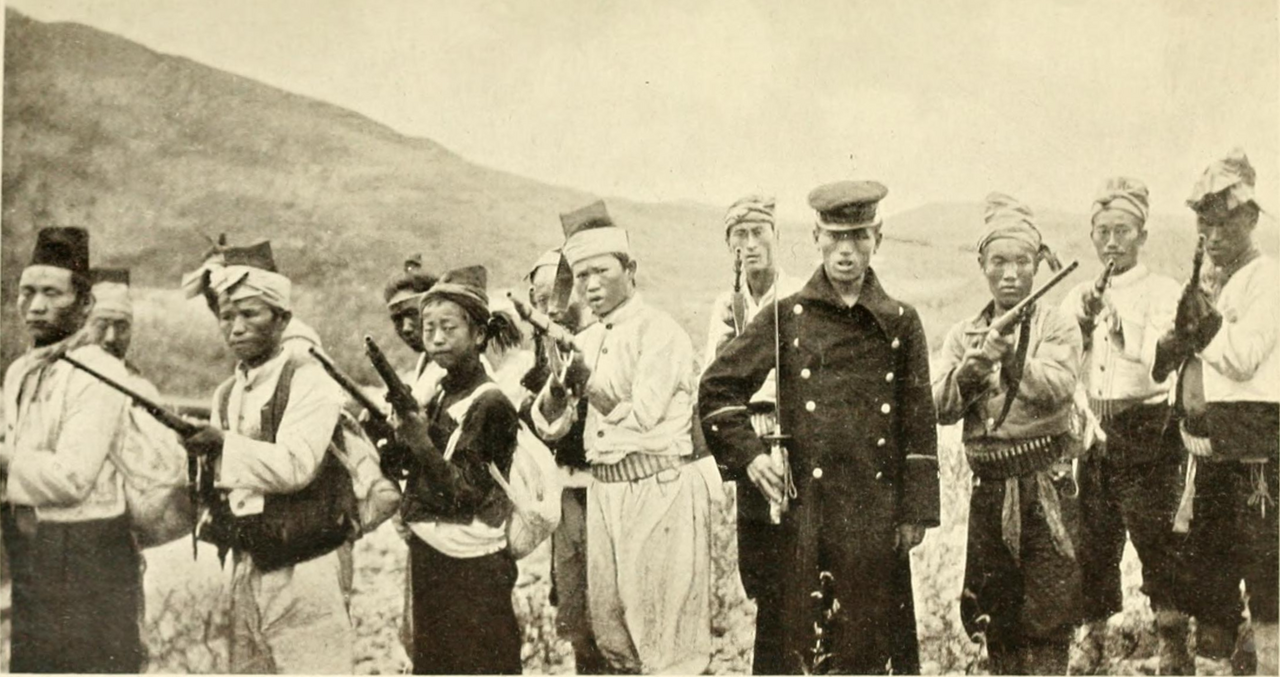
During the first invasions of Korea by Japan in 1592-1598 (known as the Imjin War), citizens drew together, formed militias and organized to fight back against the Japanese. During this period, the Japanese military had trouble believing that citizens could independently organize and fight. There were many war heroes that emerged during this historic period and you can read about them in our past article.
When theJapan-Korea Protectorate Treaty was signed in 1905, the first step toward Japanese annexation of Korea, groups of citizen militias formed the new Righteous Army. Many former Korean soldiers joined the ranks of the Righteous Army and the fighting was documented to be very intense between 1907-1910, when there were 150,000 uprisings, 2,851 clashes, 16,700 deaths, and 36,770 wounded, for a total of 53,000 Righteous Army casualties. Therewere over 60 separate militia groups in the Righteous Armies and they fought tirelessly to try to reverse the occupation. In 1910, 10,000 Righteous Army troops attempted to liberate Seoul, but could not resist against 20,000 Japanese soldiers who were better equipped and they ended up disbanding. Members of the Righteous Army mostly fled into Manchuria and Russia to organize into smaller groups and continue their fight in different areas.
Continuation of the Resistance
Resistance continued after the Righteous Army disbanded as a unified group when they mostly fled to Manchuria and Far Eastern Russia. Several significant resistance battles and counter battles took place in 1920. We will look at them briefly.
Hong Beom-do
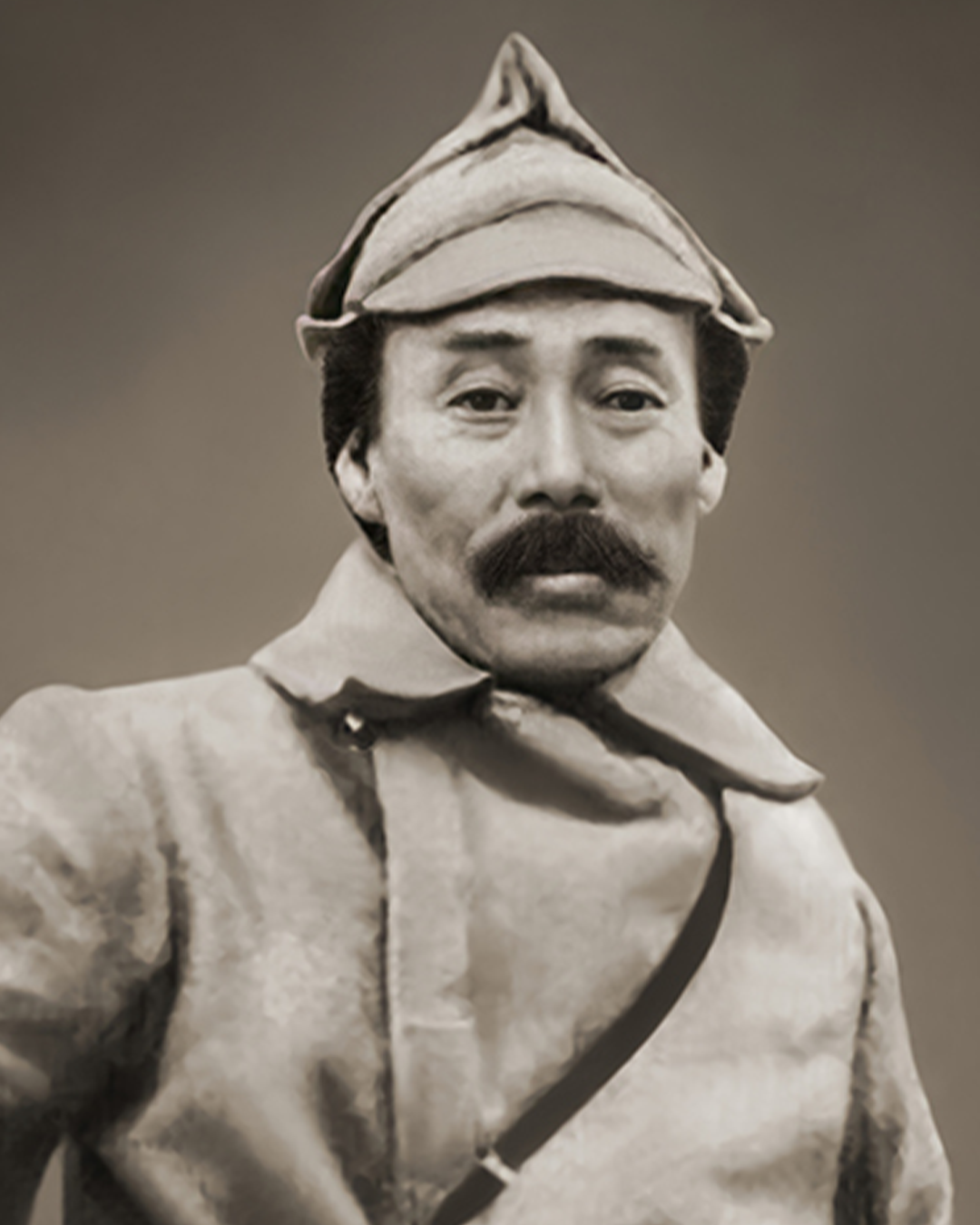
General Hong Beom-do.
One of the most significant names throughout these resistance battles is that of Hong Beom-do. He had participated in the March 1 Movement and relocated to Manchuria. He was a key figure in all of the battles listed below and was highlighted in President Moon Jae-in’s Memorial Day speech in 2020 as a true war hero of Korea. Below is a brief summary of the major battles that he strategically won. The most important facts here are that the resistance armies proved they existed – they were a force not to be ignored and they were willing to give their lives for their country.
Battle of Samdunja (삼둔자 전투)
The Battle of Samdunja was fought on the banks of the Wolshin River in Manchuria, between June 4-6, 1920. In late May, a combined group of the Korean Independence Army and the Northern Korean Military Department tried to come into occupied Korea for the first time. The combined forces, led by Hong Beom-do, gathered in Bong-oh Dong, Manchuria, waiting for the Japanese army to arrive. When they didn’t arrive, they decided to launch a preemptive strike.
Early on June 4, Hong’s unit of the Korean Independence Army and another unit led by Choi Jin-dong left Bong-oh Dong, crossed the Wolsingang River, crossed through Gando and across the Dunman River where they wiped out a platoon of Japanese military police at the border. Japanese troops were dispatched, but when they couldn’t find the independence forces, they slaughtered civilians instead.
The pursuit continued and on June 6, the independence units fired from above the Japanese and killed about 60 of them. The Japanese army retreated.
This series of back-and-forth skirmishes set precedents for the battles to come. The Japanese felt emboldened to cross the border into Manchuria to pursue independence military units. At the same time, the independence fighters felt victorious in their success. They were able to fight back against the occupation forces.
Battle of Bong-oh Town or Bong-oh Dong (봉오동 전투), also called the Battle of Fengwudong (鳳梧洞戰鬪)
The Japanese army headed toward Bong-oh Dong in order to confront the independence fighters. Independence leaders Hong Beom-do and Choi Jin-dong decided to attack the Japanese army in Bong-oh Dong. They evacuated the villagers and went north of the village to set up in a defensive position.
When the Japanese arrived on June 7, they were ambushed and defeated. Hong and Choi had carefully placed their troops in strategic locations and lured the Japanese into the ambush. Once again, the Japanese had to retreat.
The Hunchun Incident
The resistance armies continued to organize, train and push back after the Bong-oh Dong success. The Japanese became increasingly concerned that the Koreans in the far eastern Russian province of Primorsky Krai were becoming too influenced by Bolshevik ideology. Japan and Russia had fought the Russo-Japanese war of 1904-1905 over control of Manchuria and the Japanese wanted to suppress these influences and stop the organization of the Korean resistance.
On October 2, 1920, the Japanese consulate in the Chinese city of Hunchun was attacked and burned. The Japanese said the attack was carried out by the Korean Independence Army and that thirteen Japanese were killed. They embellished the story to say that the Koreans committed indiscriminate acts of murder and pillaging, including looting local shops. Historians, however, argue that reality is quite a bit more complex and that Chinese bandits carried out the attack to try to frame the Korean Independence Army. The Japanese used the incident as the reason to invade into Manchuria.
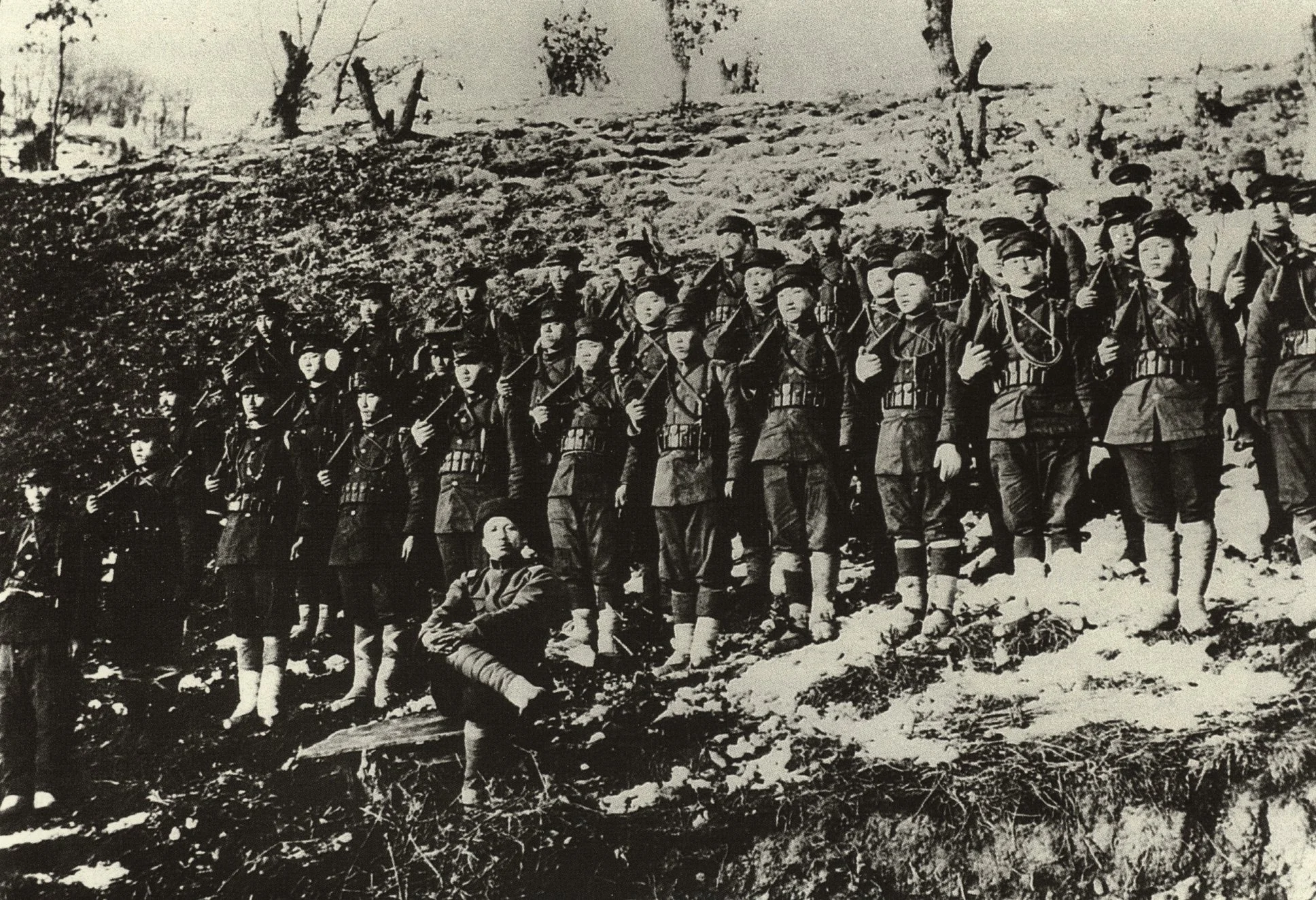
Battle of Cheongsan-ri.
Battle of Cheongsan-ri (청산리 전투), also called the Battle of Qingshanli (靑山里戰鬪)
The Japanese dispatched troops to Northeastern China and Far Eastern Russia to try to establish control. On their way back, they ended up in a heavily wooded part of Manchuria called Qingshanli. From October 21-23, Korean resistance forces battled with Japanese forces. The Korean forces were victorious, though the numbers of casualties continue to be debated.
Gando Massacre
The Japanese had already begun a scorched earth campaign in response to the Battle of Fengwudong. After the Hunch’un Incident, they increased their attacks and invaded the Gando (Jindao in Romanized Chinese) area in order to eliminate the Korean Independence Army. Gando is an area on the border between Korea and Manchuria. The Japanese army surrounded the village, gathered everyone into a single place, shot or stabbed the men, raped and murdered the women, murdered the children and burned all of the villages, food stores and livestock. When Koreans who had fled tried to return in order to bury their dead, the Japanese army attacked again, gathered the bodies and burned them. The atrocities took place over 27 days – until November 5 – and killed an approximate 3,500 people. This incident, amongst many others, shaped Korean’s attitudes about Japan and the occupation.
Vietnam
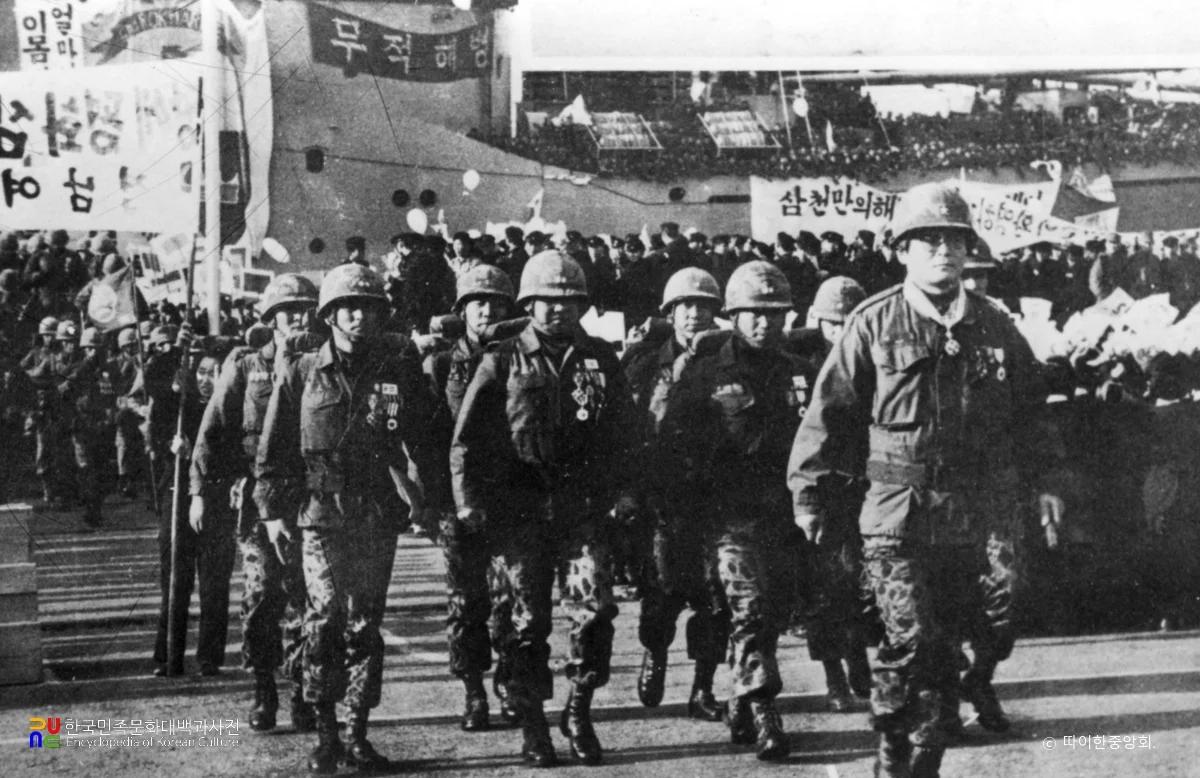
South Korea sent 350,000 troops to fight in the Vietnam War between 1964 and 1973. South Koreans participated in army, navy, marine and air force operations as an ally of the United States. President Syngman Rhee saw the redeployment of Korean War troops to Vietnam as a way to strengthen ties with the United States and request a larger US presence in South Korea in return. President Park Chung Hee, who took over in 1962, saw economic benefits to helping the US by receiving military equipment and economic aid.
Regardless of the military or political reasons for helping the US, South Korea sent a very large number of troops to fight and at by 1969 they compromised 9% of foreign troops in the war, but by 1972 compromised over 60%. Money received by the US, especially for the manufacture of military equipment, funded conglomerate growth in South Korea.
The entire Vietnam War is not without controversy and South Korea’s participation the Vietnam War is not without controversy. South Korean troops are accused of participating in multiple war crimes and that fact should not be ignored. War is always beyond ugly. However, there were also numerous, conscripted soldiers who were there because they had no other choice and died or were injured as a result. 5,099 died and 10,962 were injured.
Conclusion
Korea’s long history is very full of war. Recent history is even more replete with conflict. Memorial Day in the US is a time when we reflect on the sacrifices made by men and women serving to protect this country. However, so many of those sacrifices were made physically elsewhere – in someone else’s country. For Koreans, Memorial Day brings countless memories of conflict exactly where they are. It is a reflection of external threats that physically changed landscapes, structures, families and lives. It is a grappling with how fighting for sovereignty causes change and adaptation, compromise and sacrifice, division and national identity. Sometimes wars happen out of economic desperation. War usually happens as a defense of and therefore control over ideology. Whatever the initial cause, everyone loses so many things in war. That loss is what we need to reflect on for Memorial Day.
Further Reading:
https://www.koreantopik.com/2025/06/why-is-koreas-memorial-day-on-june-6.html
https://www.nationaldaytoday.us/memorial-day-in-south-korea-june-6/
https://nationaltoday.com/memorial-day-in-south-korea/
https://www.donga.com/en/article/all/20230301/3992554/1
https://timesmachine.nytimes.com/timesmachine/1920/12/24/103519339.pdf
http://www.asianinfo.org/asianinfo/korea/history/independence_army.htm
https://www.newworldencyclopedia.org/entry/Battle_of_Chingshanli
https://military-history.fandom.com/wiki/Battle_of_Qingshanli
Film:
The Battle: Roar to Victory - 봉오동 전투 – 2019
Watch on Viki, Amazon Prime, Hoopla, Kanopy, PlexTV, Amasian
This film centers on the Battle of Bong-oh.
This series covers the battles and events of the Korean Independence Army leading up to the Gando Massacre