
KOREAN LITERATURE CORNER - June 2026
By Josh Kim
ORIGINS OF THE HAETAE - 해태
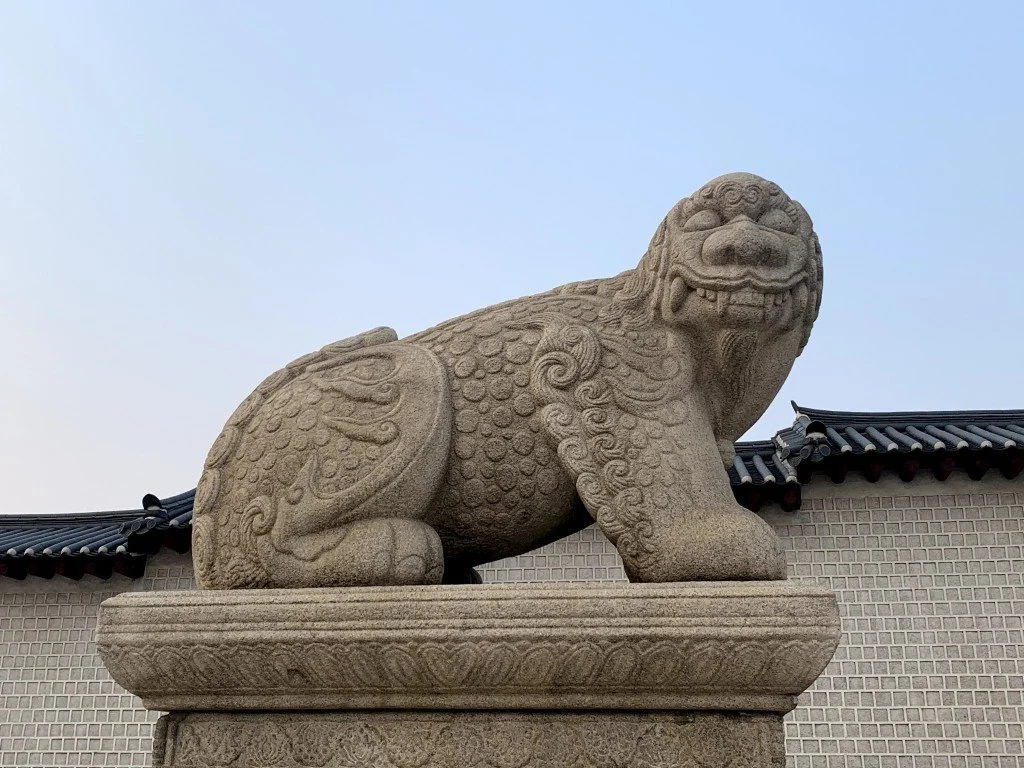
Haetae in Gyeongbok Palace.
This month won’t be a story. Instead we’ll be looking at a brief origin of the mythical Haetae (해태), also known as Haechi (해치)– which since 2008 has been the official mascot of Seoul.
Above is a statue of a Haetae at Gyeongbokgung. The creature has origins from the Chinese myth, Xiezhi. It has the body of a dog with the head of a lion and is covered in scales.
Haetae was believed to have the ability to completely distinguish between right and wrong. With its single horn, Haetae would pierce corrupt officials and people committing injustices. Ancient Korean officials wore Haetae symbols on their robes because of this.
During the Joseon dynasty, Hanyang (modern-day Seoul) was founded as the Joseon capital. However, the city geomancers feared the fire energy coming from the Gwanaksan Mountains, believing it could engulf the newly built Gyeongbokgung Palace in flames.
To fight this energy off, Haetae statues were carved and placed around the palace. The Haetae were said to be able to eat the fire, as well as ward off against other evil and disasters. The famous stone statues standing in front of Gwanghwamun Gate today have been keeping watch over the heart of the city since the palace was rebuilt in the 1860s

In 2008, a cute Haetae named Haechi (해치) was introduced as the new mascot of Seoul. In 2024, Haechi was rebranded into the pink creature seen above.
정말 귀여워요!