
KOREAN ART NEWS - Sept 2025
By Hyun Lee
Hyun Lee is a media artist from Seoul who resides in Chicago. She holds a BA from Ewha Womans University where she majored in art and art history with a thesis on the Children's Education Museum at Yonsei University. Later, while working as an art news reporter and freelance designer at the Seoul Arts and Culture Foundation, she contributed to a book called Post Human: New Media Art (2020). She also participated in the CICA NMAC 2020 Collaboration Project and the 2022 Seoul Pop Culture Convention. Currently, she is working on a Master's degree in Art Technology at the School of the Art Institute of Chicago, Chicago Graduate School of art.
Hyun’s words about her art:
ARTIST STATEMENT
As a reflection on the potential crises in our media environment, I approach the interaction with media technology, the body, and paradoxical situations in a way that feels unfamiliar.
My artistic practice actively explores and engages with the potential threats and paradoxes that arise as media technologies advance. For example, facial recognition technology, which is used to prevent potential terrorism, can also threaten personal privacy and image rights, and inadvertently lead to personal discrimination. Moreover, companies use AI to trap users in an endless flow of products and information based on identified preferences, thereby narrowing their exposure to diverse perspectives.
In my work, I incorporate various media such as computer vision, Unity, Arduino, and VR. I create and modify games we used to play as children as a method to help audiences easily access and reflect on the potential threats and contradictions triggered by the media environment. This approach enhances the accessibility of the work, naturally prompting audience reactions, and creating an opportunity to reconsider the impact of media on everyday life.
Through interacting with the work via their bodies or interface elements like a computer mouse, the audience experiences a real-time, unfamiliar interaction between their body and media technology. By encountering somewhat distorted versions of familiar technologies, such as surveillance camera functions or 3D mouse features, the audience is prompted to reflect on the hidden threats and effects of common media technologies that they might not have previously considered in their everyday lives.
Art project 1: Anytime Mom (2025)
The concept of the "Anytime Mom" chatbot is a parental-style assistant that combines firm yet caring guidance, functioning like an emotional counselor and guardian of kindness. Drawing on the field of robophilosophy, which examines the philosophical and ethical responsibilities of robots and AI, this project seeks to explore the ideal interaction between humans and artificial intelligence through conversation. The chatbot, designed to provide emotional care and support, serves as an always-available conversational partner. It listens without judgment, disappointment, or anger, offering a safe space for individuals to express their emotions freely. Rather than simply observing, the viewer becomes an active participant. They are encouraged to "vent" their emotions and psychological states—feelings often difficult to articulate in real life—within the secure confines of the chatbot interface. Through dialogue, participants can seek advice, receive empathy, or release negative emotions such as frustrations with specific people or situations. Additionally, the chatbot can offer comfort to those grieving or missing family members, providing solace through conversation.
My family and I live in different time zones created by physical and temporal distance. So, I had difficulty talking on the phone at any time I wanted, and I thought of an object that could care for emotions beyond language and the barrier distance. Although it seems functionally similar to a general chatbot, I tried to create an AI being as a character and mother, aiming for a 'perfect' mother by synthesizing the expectations of the mother to a child, the role of the ideal mother, and the language habits of a real mother. I created a chatbot for AI Mom because I was curious about the mechanical personality of AI, the emotions, how similar she could sound to a real mother, how much she could complement her role as a real mother, and whether she could live up to the 'perfect mother's image' that filled the gaps between real human emotions and her ability to communicate. For example, I asked, "Did you eat?" and asked, "Did you eat vegetables and fruits?" All questions related to lifestyle and health were put into the AI, such as questions about health habits and questions about your body’s condition. For example, "I was tired and rested." (When I made it, I received feedback that it was a characteristic of Asian mothers. When it gave an answer similar to my mom, I was very surprised, and when I saw a gap with my mom, I was curious about the limitations of programming and the principles of the AI system. But I was also disappointed by the AI system. For me personally, the audience's comment that it was creepy was the best.)
Art project 2: Hide and Seek2: Drawing Your Own Mask (2023)
Hyun Lee, interactive installation, p5js


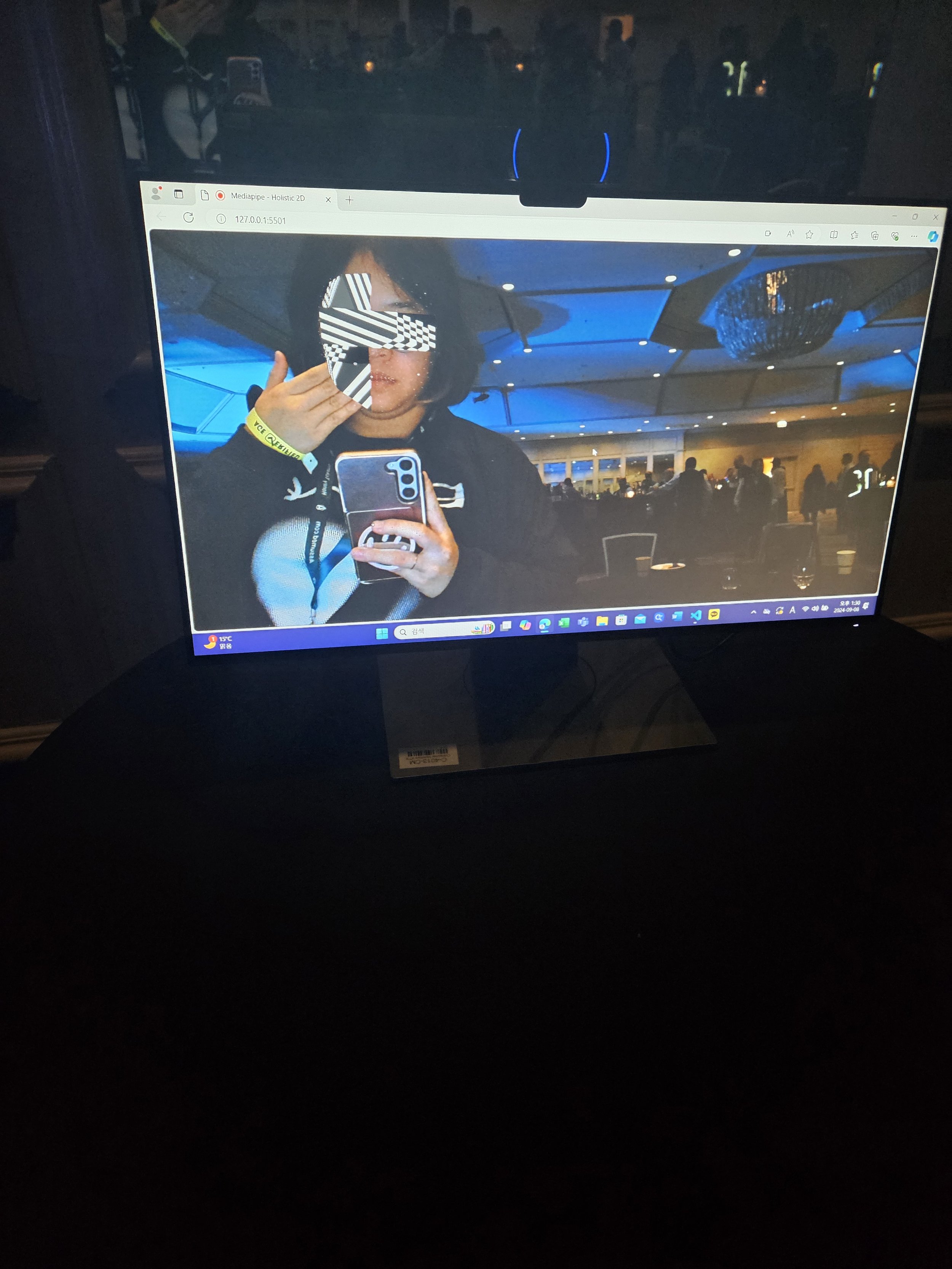

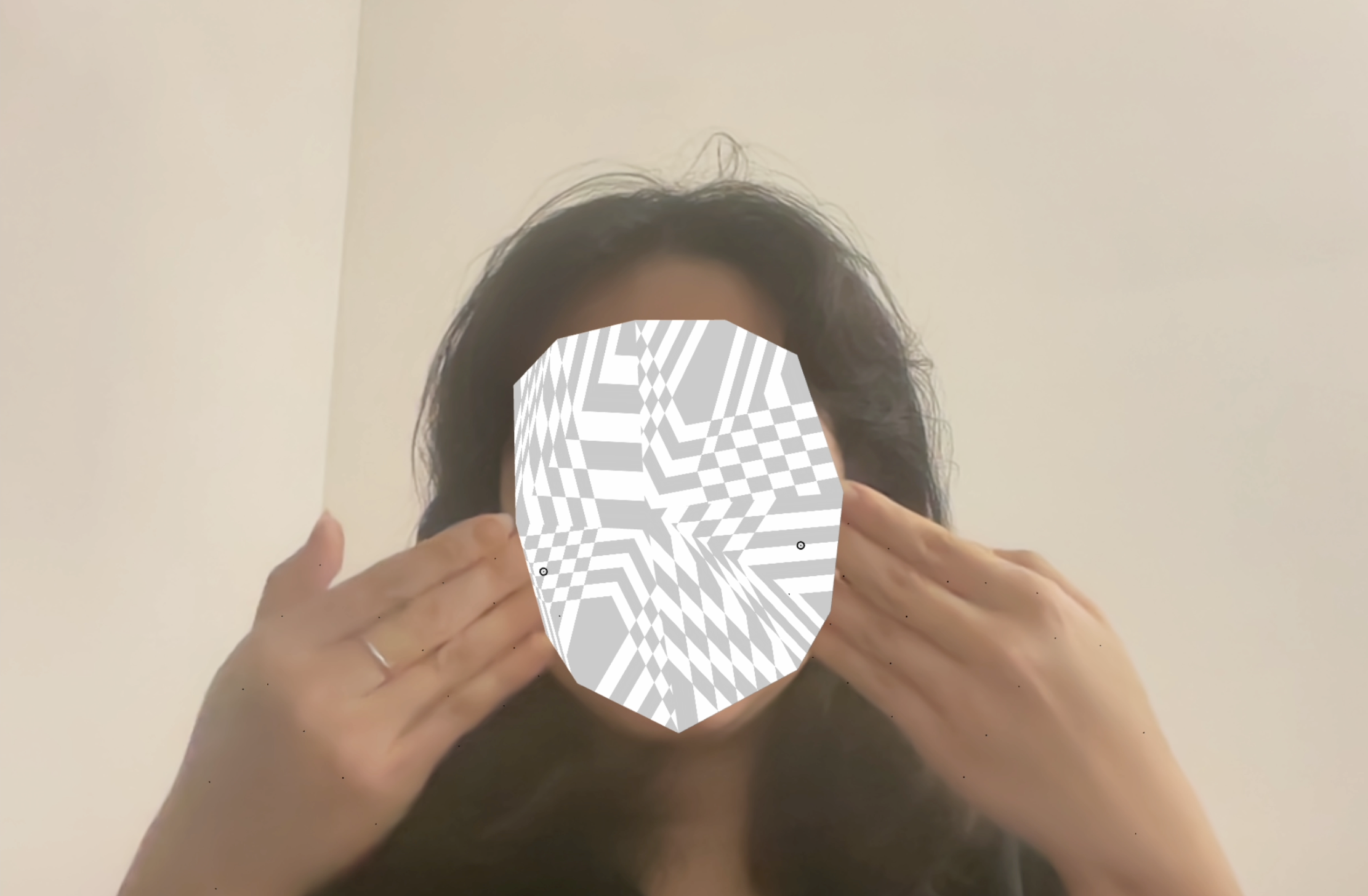


This interactive computer vision piece provides an opportunity for participants to engage with the artwork, exploring ideas of distortion while critiquing the weaponization of facial recognition technology. A visually rewarding experience emerges when participants conceal their faces, exposing the often obfuscated underbelly of surveillance technology. Through the process of finding hidden mosaics, the meaning of the technology can be considered.
*Instruction: Hide and Seek2: drawing your own mask (2023), interactive installation, p5js
(1) Stand in front of the webcam.
(2) Move the mouse and draw your own pattern on your face.
(3) Move around.
Artist Memo
1.The relationship between the camera, the monitor, and the audience's gaze is explored.
2. Irony: The camera is activated but remains invisible, causing the audience to feel strange, confused, or relieved.
3. The attitude of appreciating the work involves a subtle exploration of why it works—the relationship between what is seen and what is invisible. The audience can explore the body in a slightly unfamiliar way by groping their face.
Work 1: “A simple mask with a sense of relief” allows individuals to defend themselves from the camera through their hands, which are part of their body, without using tools.
Work 2: “An active and creative mask” is presented through mouse-drawn images. While not as precise as makeup, it emphasizes creativity. Fumbling through the face is encouraged.
4. Motivation for Production: Challenging preconceived notions about race and preventing personal datafication, even from AI, enables protection and avoidance of becoming a victim of surveillance, witch hunts, and potential online crimes (such as sexual victimization) in the internet world.
5. By blocking identity and creating depersonalization, individuals are shielded from being sold by multiple people online, preventing them from becoming data for commercial or surveillance purposes.
6. This is camera (gaze) and body exploration in an ironic way. De-digitalization is achieved through a de-individualization (de-characterize) method that involves covering the human body with hands or a mouse. This prevents individuals from becoming victims of commercial or political tools as data, including surveillance and potential crimes.
7. Exploring one's own body through the process of groping the human body in front of a monitor to cover one's face while simultaneously becoming data, resisting the reality of surveillance.
Art project 3: Never Ending Story (2017)
(Solo exhibition: Scene of data), 2017, Unity, interactive installation, VARIABLE DIMENSION
Data is produced by itself, by users, or through social media consumed by users. In this exhibition space, I displayed the whole structure of the phenomenon of monitoring my audience members through their consumption and the flow of data: who can play, who can watch, and who can track.
This was a 3D art game that implements Kakao Talk data spatially and depending on what data the audience chooses, the color of the ball changes and you can meet three different endings depending on the score. Through this game, we compared ourselves surrounded by a lot of data, and at the same time it induced us to solve the problem of what data we should choose as audience, player and performer.
Today, we are exposed to various social network environments such as Facebook, Twitter and Instagram where we communicate with new people and make relationships. We have access to a lot of data every day but not all the data is useful to us. I created a game where the color of the player changes depending on what the player is exposed to and the players will see a different ending. This reminds us of our close relationships and makes us ponder how we should treat and use data.
I showed the flow of data in this exhibition, which represents the situations where data is produced through social media, consumed by its users and I monitored them in their ways of consumption.
Art project 4: AI MANTRA (Vr mediation) (2024)
Hyun Lee, 2024, VR, Unity , Interactive installation, VARIABLE DIMENSION
AI, though a technology, much like the invention of the camera that once revolutionized the world of painting and catalyzed the birth of Impressionism, is now bringing about an even more profound change in our lives. AI models are being created to reduce labor costs, produce films, and compose music, which in turn poses a challenge to traditional artists and creators. Simultaneously, it inspires artists with advanced tools, embedding itself deeply into the fabric of our existence. In an effort to understand and contemplate this influential yet intangible force that transcends disciplines, I’ve borrowed the imagery of Buddha—the founder of a transformative movement—to create a new form of meditation. By synthesizing the faces of eleven pioneering AI developers, I have crafted an image that serves as both a focus for contemplation and a space for reflection.
Background:
1950 Alan Turing “the Turing Test” - id conception 1st suggest
1956 AI conception was informed in Dartmouth Conference
1956 John McCarthy, while at MIT -> AI defined at the Dartmouth Conference
1957 Frank Rosenblatt , perceptron model (how computers can recognize pattern and study)
2004 Canadian Geoffrey Hinton, University of Toronto -> With collaborators, proposed the launch of a new program, "Neural Computation and Adaptive Perception" (NCAP), which today is named "Learning in Machines & Brains".
2012 Canadian Alex Krizhevsky, ImageNet winner [Geoffrey Hinton was his PhD advisor] - Won the image recognition competition using deep learning and neural networks on GPUs. Prior to this, computer recognition percentages had never topped 75%.
2015 Microsoft 96% - a false claim that Microsoft’s AI matched 96% of human brain power, but was a result of increasing computing power and vast amounts of training data available. AI took off significantly in 2015.
2017 David Silver’s Alphago (an AI program that plays the game Go) won 100 games and lost zero.
Art project 5: The Shape of the Sound (2019)
Hyun Lee, The shape of the sound, 2019, Efter effects, Logic pro X
I tried to explore the value of sound by including its source or meaning and focusing on the sound itself. First, I wanted to make a melody and double track the sound to highlight the rhythm and space of the sound, and try to construct a space through the sound. At this time, I avoided the idea of minimal particles and used Calaidoskov (kaleidoscope) and decalcomania styles to mysteriously decorate the space with sound.
Art project 6: Projection Mapping (2015)
Hyun Lee, Jejungwon, After effects, May 2015
To celebrate 120 years of Yonsei University's Severance Hospital, I organized an experiment where I mixed the two heterogeneous spaces of graphics and reality by combining the space of the reality with that of images and integrated the time/space of the past and that of the present in the historic space of Jejungwon, the first modern hospital in Korea.
Art project 7: Companion Drawing (2024)
Hyun Lee, Companion drawing, 2024, interactive installation, Arduino, Servor motor, temperature sensor
The air and atmosphere surrounding living organisms form the foundation for their existence. By visually representing the act of breathing and the atmospheric conditions (such as temperature) through drawing, I aimed to capture moments of interaction and connection with "breath." The device is affected by the changed atmosphere which activates different angles of drawing. The device records what we usually cannot see. Also, we can feel we are alive with the environment so we can remember we are connected by the environment.
Art project 8 : The Scene of Existence and Color (2019)
Hyun Lee, The scene of existence and colo(존재의풍경)_ Openframe works, Computer, Kinect sensor, Beam Projector, VARIABLE DIMENSION _2019
2019. 6. 14-18, Media +Space gallery In Yonsei University
A sensor captures the red, green and blue (RGB) colors from the clothes of the audience, and the ‘situations’ when the audience faces this work are transformed into digital data. This structured white cube can be reinterpreted with personal experience, and the audience who watch this work can newly recognize themselves in this space.