LETTER FROM THE EDITOR - VOL. 17
KCCNYC Monthly - October 2025
By Eun Byoul Oh
Happy Chuseok everyone!
This week, Korea celebrates its biggest holiday of the year, Chuseok, which is also nicknamed Korea’s Thanksgiving. The holiday has another name, Han-gawi, which means a big day in the middle of Autumn. The holiday falls on the 15th day of the eighth month of the lunar calendar every year and South Korea celebrates the holiday for three days. This year, Chuseok falls on October 6, 2025.

Thank you everyone for joining us at the Korea Fest!
Hangeul Day was also on the 9th, and we take time to appreciate the writing system of Korea, which was created by King Sejong with the specific goal of creating a writing system that would allow everyone to learn how to write. With the creation of Hangeul, Korea, then Joseon, was able to extend literacy education to people of all social classes, including the commoners. In every semester of Starter Class, KCCNYC takes time to teach the beginners the engineering of Hangeul as stated in Hunminjeongeum (훈민정음), the manuscript of the Korean alphabet written by King Sejong.
KCCNYC participated in Korea Fest hosted by KAAGNY and we were able to come together as a community and play some traditional Chuseok games. As you may have seen on our Instagram, families gathered around to play Yootnori, Jegi-Chagi, Ttakji, Gong-gi, and many other games during the bountiful holiday.
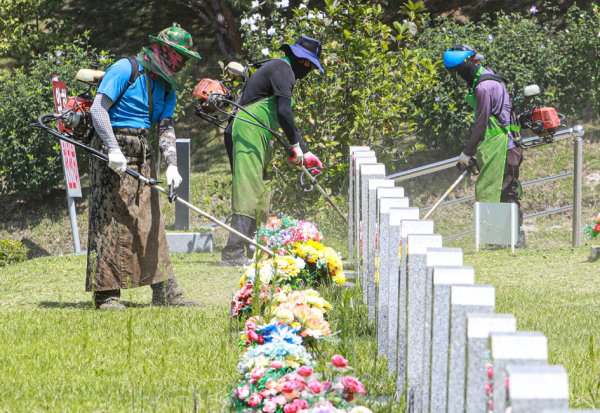
Koreans take care of their ancestral tombs as a way to pay respect to their ancestors.
Although there are multiple stories of how Chuseok originated, the most well-known, popular belief is that the tradition of Chuseok came from Korea’s ancient kingdom Silla’s Gabae (가배), which was a month-long weaving competition between two teams. The winners of the competition were treated with a feast.
On Chuseok, families perform the ancestral ritual called Charye (차례) to pay respects to the ancestors. During Charye, we set a food table according to traditional rules. However, the origin of the rules for setting the table have been disputed over centuries. Today, some families prepare the ancestral ritual in a modern style, respecting what the immediate ancestors liked to have when they were alive.
Families also go to family burial grounds to pay respects to their ancestors. The term Sungmyo (성묘) is a ritual to take care of the tombs of the deceased by cutting grass grown over the tomb. The caring of the burial ground is called Bulcho (벌초). In a modern context, many deceased are cremated and put in a columbarium, so the practice of 벌초 is increasingly less common.
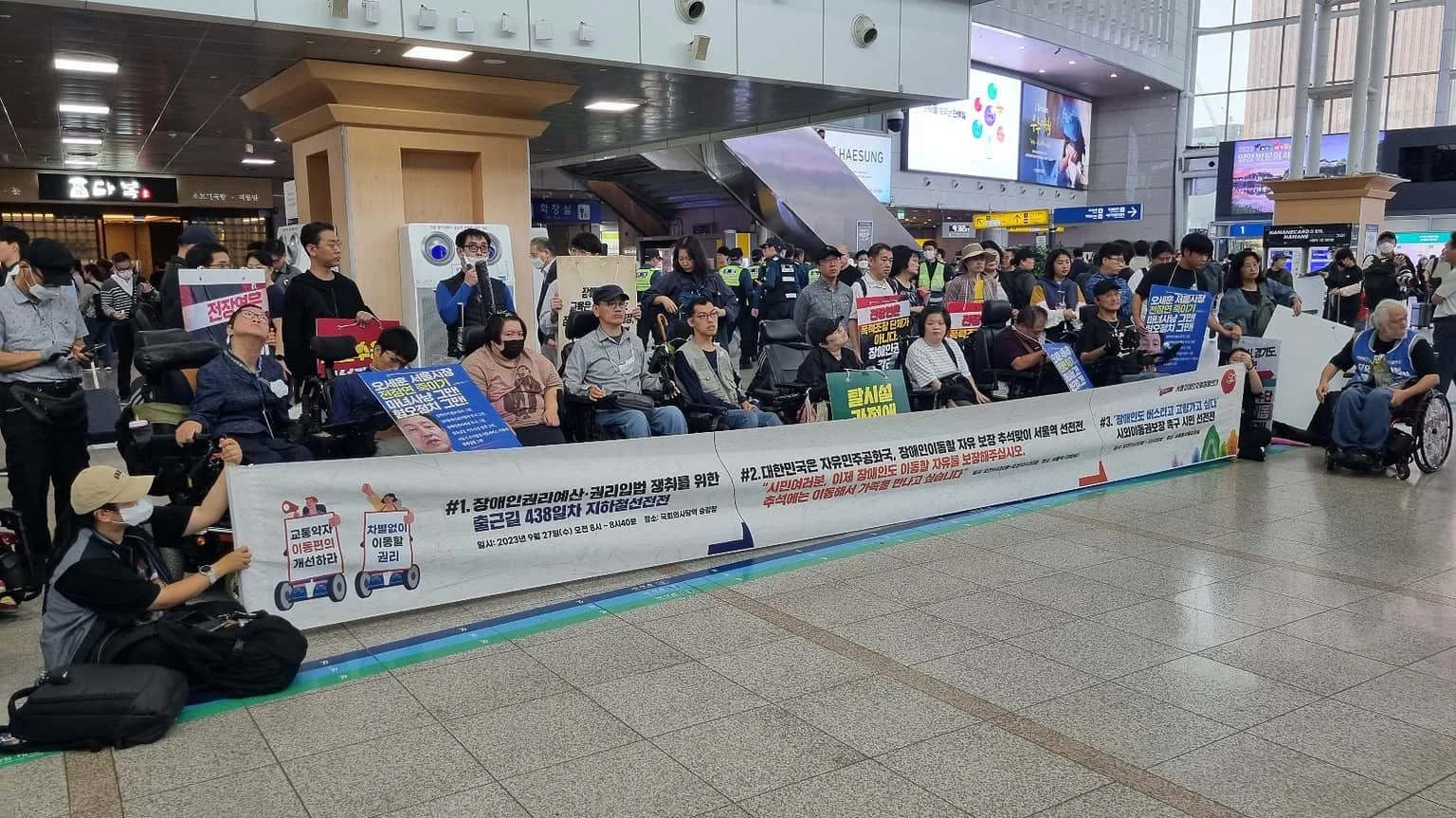
SADD (Solidarity Against Disability Discrimination) demonstrated for the rights of people with disability to board an inter-provincial transportation to go to their homes for Chuseok.
Most importantly, Chuseok is a time of happiness and a time for extended families to gather. We eat so much food and catch up with other family members. We also watch the big, full moon with the family. At KCCNYC, we remember all of those who are celebrating Chuseok in different parts of the world. Chuseok is a great opportunity for Korean immigrants in the U.S. to remember and celebrate their Korean identity.
KCCNYC is proud to remember the traditions of Korea, and the diversity that we have in our community. We believe our community is a true statement to what makes the United States the United States. We will continue to strive to secure the vibrant colors we have as a community.
Moreover, we remember those who are separated by the Korean War, those who lost their homes and are displaced. Lastly, KCCNYC also remembers the members of disabled community in Korea who have difficulty traveling to their homes due to the lack of availability of accessible transportation for long-distance, inter-provincial travel. We wish all of you a very warm and happy Chuseok.
풍요로운 한가위 되세요,
Eun Byoul Oh